Aquatic Ecology
This topic addresses the health, productivity and connectivity of the river's aquatic ecosystems, of which fisheries are one part.
Download this section (PDF)
Key objectives
- Maintain aquatic habitats, primary productivity and riverine biodiversity.
- Preserve longitudinal and lateral connectivity between the mainstream, tributaries and floodplains.
- Provide environmental flows adequate to sustain ecological functions.
What the guidance addresses
The guidance covers habitat protection, environmental-flow provision, wetland and riparian-vegetation considerations, and ecological monitoring.
150. The objectives for aquatic ecology are:
- Protect and conserve aquatic habitats as far as practicable during the development and operation of mainstream dams.
- Minimize the impacts of the construction and operation of hydropower dams on the aquatic ecology and ecosystems of the lower Mekong River system.
- Reduce the risks of the proliferation of pests, parasites or diseases within aquatic ecosystems in hydropower impoundments on the Mekong mainstream.
- Sustain aquatic ecosystems reliant on the flow regimes of the river.
151. In the context of this Guidance, aquatic ecology encompasses primarily the biota of rivers other than fish, and biological processes such as primary production and nutrient spiralling. Food webs in large rivers such as the Mekong derive most of their energy from algae floating in the water, and a lesser amount from organic material washed in from the terrestrial systems. Invertebrates such as insects, snails, mussels and crustaceans feed on algae and organic material, and invertebrates, in turn, form much of the food for fish and other large consumers including frogs and turtles. Mekong dolphins in turn feed on the fish. If the aquatic ecosystem is damaged, the impacts pass through the food web, altering the numbers and the species of all those organisms.
152. People consume items from every step of the food chain including algae, invertebrates, fish, frogs and turtles. These organisms comprise the OAAs, or Other Aquatic Animals, which are included in fisheries catch data. In fact the name OAA is unfortunate, because the algae consumed by people is also included and is a plant rather than an animal.
153. The Mekong River supports a number of species considered to be of conservation significance, including species such as the Mekong dolphin (Orcaella brevirostris), the Asian giant softshell turtle (Pelochelys cantorii) and the Asiatic softshell turtle (Amydia cartilaginea) which are listed by International Union for Conservation of Nature (IUCN) as critically endangered, endangered and vulnerable respectively. All the IUCN listed species have seen population declines arising from a number of factors including habitat degradation and loss, harvesting and a reduction in food availability. Existing impoundments have been one contributing factor, and construction of additional impoundments will add to the pressure on these species by obstructing movements, reducing key habitats and reducing the availability of foods such as invertebrates and fish. Because rivers are linear connected systems it is not possible to designate effective protected areas for riverine species unless the protected area encompasses an entire catchment or sub-catchment.
154. Potential risks to aquatic ecology should be comprehensively assessed. Table 5.1 provides a summary of potential risks that can arise to aquatic species and habitats with the development and operation of mainstream dams. The degree to which any of these may be experienced depends on project configuration and operations. These risks should be evaluated to see which may be relevant to any individual project.
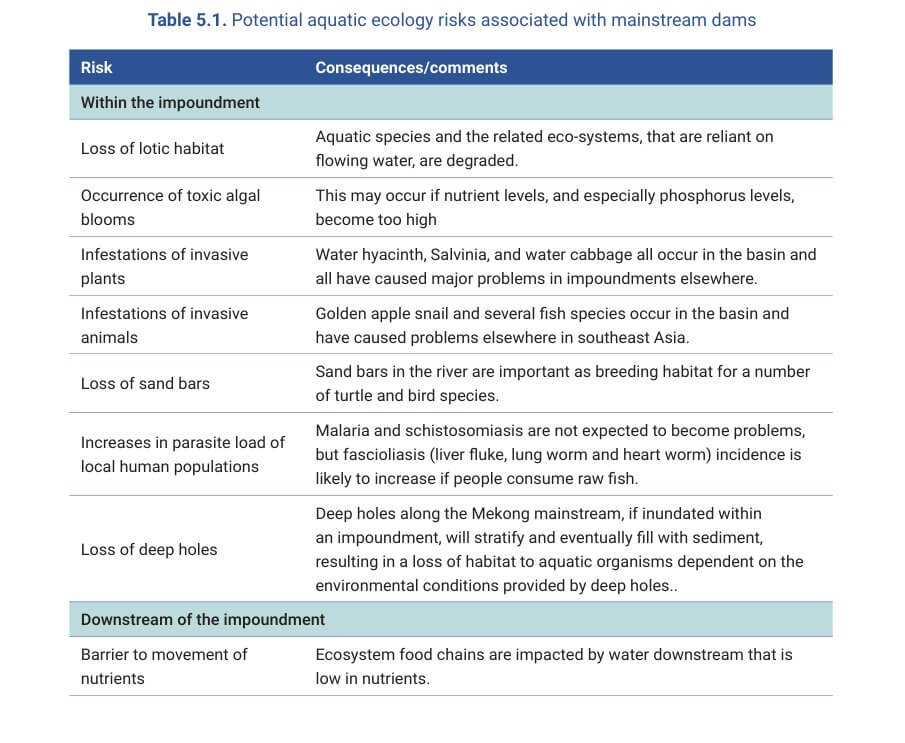
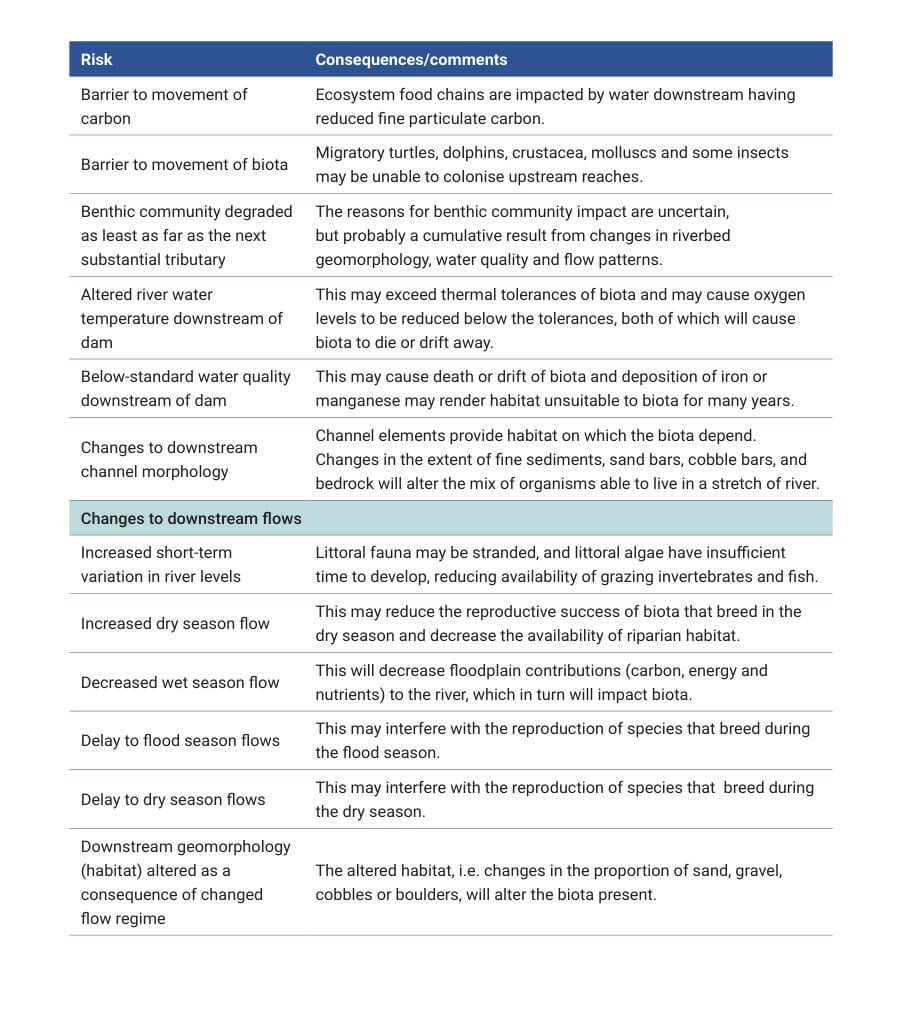
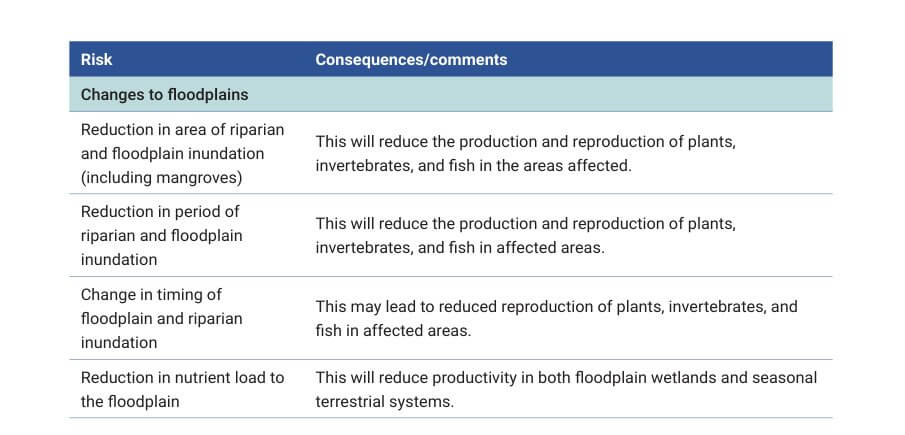
155. In addition to risks from the project development and operations on the existing aquatic ecology of the Mekong River, some aquatic ecology-related risks may arise during the operations stage for which the owner/operator of a mainstream dam may need to develop or contribute to management measures. These risks may influence considerations relating to project design or planning for operations, hence should be included in a risk assessment:
- Blooms of cyanobacteria (blue-green algae) may occur within the future impoundment if nutrient levels are high and turbidity low. Many cyanobacteria can produce toxins which can affect fish, invertebrates and stock or humans that drink the water.
- Three aquatic plants – Eichornia crassipes (water hyacinth), Salvinia molesta (water fern) and Pistia stratiotes (water cabbage or water lettuce) – are known pest species that can affect impoundments. Although these are not native to the Mekong basin, are all known to occur occasionally in dense growths on Mekong basin water bodies. All three have caused problems in tropical impoundments in other regions, such as Africa and Australia.
- Increases in parasite loads to human populations may occur in relation to changes in consumption patterns of fish and other aquatic animals (OAAs).
156. The monitoring approach for aquatic ecology should be shown in the PNPCA information to be sufficient to inform design, to support modelling for impact prediction, and to help with later impact evaluation. Clause 23 provides basic principles to guide design of the overall monitoring network. The following clauses can be used as a guide, and varied to suit project-specific conditions.
157. An overall design for data collection for evaluation of aquatic ecology risks and potential impacts should be established and described in the PNPCA information. Because aquatic ecology is an important indicator of river health, which may be a factor influencing trends for fish and livelihoods, it is important to understand changes that are occurring due to the project or other influences. The monitoring design should be set up for the pre-project sampling so that post-development monitoring can make valid comparisons against preproject conditions, as well as adequately inform risk identification and mitigation planning. To have robust comparisons, sufficient pre-project data would need to be collected so that statistically significant comparisons post-project can be made (see Section 5.5).
158. Monitoring locations for aquatic ecology should be established within the future impoundment, as well as both upstream and downstream. A good design for pre-project riverine sampling locations may include:
- two monitoring sites upstream of the future impoundment;
- one monitoring site within the future impoundment;
- an array of at least three monitoring sites downstream of the future dam, extending over a distance of at least 10 km. The location of sites should seek to coincide with the general monitoring locations for other disciplines where possible; and
- a site upstream and a site downstream of the confluence with the first tributary contributing >2% of average annual flow downstream of the dam.
159. The MRC bioassessment protocols and indices (e.g. see MRC, 2010, 2009b) should be used for biological assessments in the river upstream and downstream of impoundments. These have been developed specifically for the Mekong system based on several years of sampling and investigation, they are thoroughly documented, and they are known to be effective. The bioassessment protocols and indices with equivalent function may be proposed
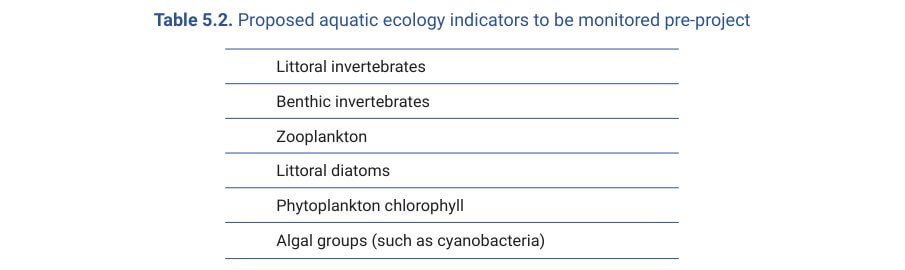
160. The assessment should include the existing MRC indicators plus some additions as shown in Table 5.2. Phytoplankton could best be monitored using a fluorometric field instrument, some of which also allow algal groups (such as cyanobacteria) to be monitored. Appropriate quality assurance procedures should be put in place, particularly for the invertebrate identifications.
161. The duration of aquatic ecology data collection should cover two years in order to establish a baseline for later comparison. Two years is important for aquatic ecology data because only one season is able to be sampled each year (see Clause 162) and to provide insight into inter-annual variability, which is substantial in the Mekong.
162. Biological sampling should be conducted twice during the low flow period, because of the following constraints in sampling feasibility under high flow conditions:
- In the Mekong, there is a very large variation in discharge between wet and dry seasons, which in turn is reflected in the change in water level. For example, the water level at Vientiane is almost 10 m higher in the wet season than the dry season.
- In the wet season, sampling from a boat would be quite dangerous because of the large logs and trees being carried downstream. The speed of the current makes it impossible to lower a grab to the river bed to obtain a sample.
- For edge sampling, the large rise in water level amounts to a change of about 35 cm per day; i.e. invertebrates in the habitat in the 1-m depth of water at the edge of the river will only have had up to three days to colonize as water level rises, so samples are more likely to reflect colonizing ability than responses to habitat and water quality.
- sampling in the low flow season only is possible in the Mekong where temperature changes between seasons are not significant. This contrasts with temperate regions where biological monitoring of rivers is normally conducted in multiple seasons. This is partly because in temperate regions, the life cycles of many of the organisms are seasonally adapted to the changing temperatures.
163. Comparisons from the pre-project monitoring results should be made with existing data and index calculations from across the basin. This should include comparisons with the MRC bioassessment data from the closest MRC monitoring sites to the project.
Impact prediction
164. Pre-project data should be analysed to look at species composition and habitat preferences, so that projections can be made as to the types of impacts to expect based on the modelled results for changes to hydrology and hydraulics (see Section 2).
165. Impact predictions regarding flows, water quality and sediments should be used to inform assessments of the degree of risk to aquatic habitats, species and ecological processes, and to identify any particularly vulnerable areas. The degree of hydrological change to downstream flows should be used to inform evaluations of the degree of any risks to seasonal flow regimes and to floodplains (see further in Clause 169 on application of a suitable model).
166. Important habitat areas should be identified based on the pre-project surveys, so that the assessments can evaluate if there are any mitigation measures that could help minimize impacts.
167. The location of the future impoundment in relation to deep pools in the Mekong River should be checked on the maps produced by the MRC.
168. The analyses of changes, impacts and mitigation options for aquatic ecology should clearly identify the residual impacts and document where these will occur in the river, in line with Clauses 7 and 25.
169. Suitable basin scale models should be used to predict impacts and assess mitigation options. The developer may apply the Downstream Response to Imposed Flow Transformations (DRIFT), the ecological systems analysis tool used in the MRC Council Study model for the lower Mekong mainstream, as was used in the MRC Council Study (MRC, 2018b) to evaluate cumulative impacts and inform development of Cascade Joint Operating Rules. An equivalent analytical approach and function may be proposed, as follows:
- The analytical approach should link flows with geomorphology, water quality, aquatic ecology and fisheries, inter alia, for the eight different zones along the river, corresponding to geomorphological zones.
- The analysis should test a range of possible operating rules and allow an assessment of which operating procedures will cause the least impact on the river.
- The analytical approach output should be used to inform decision-makers about the trade-offs of different dam configurations and operating regimes against the environmental values considered, and should guide development of Cascade Joint Operating Rules.
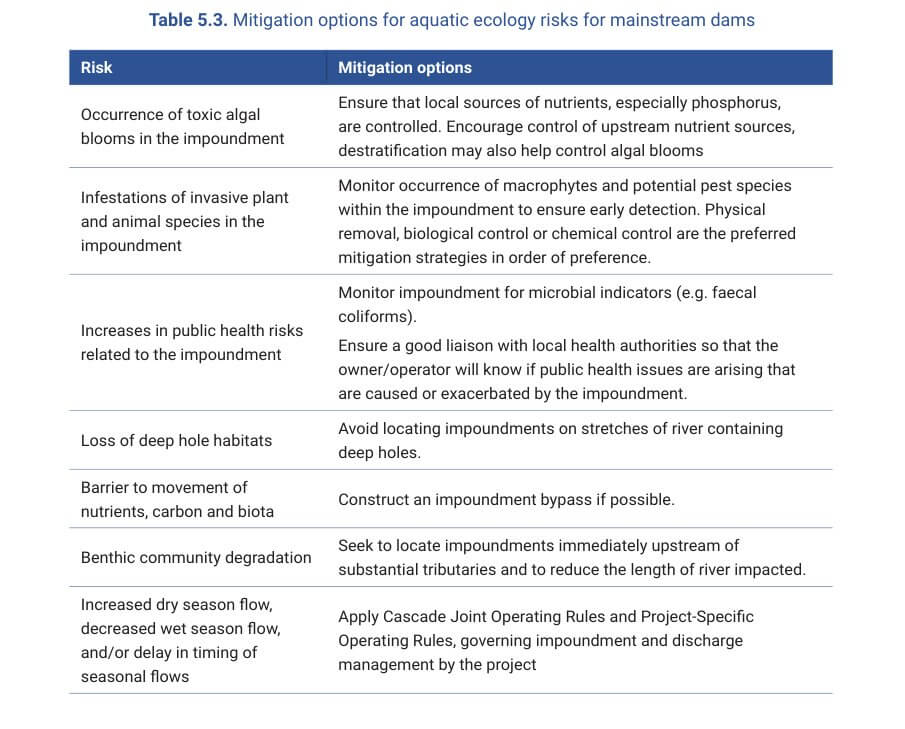
170. Mitigation options should be evaluated to determine which ones will best address identified risks. Table 5.3 identifies mitigation options that should be considered to address risks relevant to the project These are in addition to the mitigation options identified in the sections on hydrology and hydraulics (Section 2), sediment transport and geomorphology (Section 3), and water quality (Section 4). The mitigation approaches for these other disciplines in many cases will also benefit the aquatic ecology objectives. Not all of these mitigation measures would be expected to be delivered by the developer; some, such as catchment protection, would need to be undertaken by National or Provincial Agencies, and others may require a cooperative approach between the project and other institutions.
171. Even if operations are very well-coordinated to manage downstream flows and floodplain inundation, a cascade of mainstream dams will cause a larger cumulative impact to the aquatic ecology of the downstream river than the sum of the individual impacts of a number of dams, because a much larger proportion of the fluvial habitat will be lost.
172. Project-Specific Operating Rules should be developed in line with the Cascade Joint Operating Rules, to address more local area aquatic ecological objectives and ensure operations take into consideration important focal areas for mitigation measures.
173. Plans for project monitoring of aquatic ecology should take into account the guidance in Clause 26. The PNPCA information should demonstrate that plans for aquatic ecology monitoring information to be collected during construction and operation will inform indicators that may signal a need for adaptive management responses to aquatic ecology related mitigation measures.
174. The monitoring programme described in Section 5.3 should be continued during the construction and operation stages, and adapted where needed to better inform construction and operation stage information requirements for management.
175. For comparisons of aquatic ecology in the project area of influence with the pre-project conditions, the following considerations apply:
- Sufficient post-project sampling should be undertaken to enable statistical detection of changes compared to pre-project.
- The presence and size of impact on the aquatic ecosystems by the project should be assessed by comparing index values both from pre- and post-construction, and also from upstream and downstream sites.
- The species list data from sampling should provide a series of multivariate data sets that can be compared using Multivariate Analysis of Variance (MANOVA) and testing for the statistical significance of differences in ordination space.
- Examination of the data to assess whether any particular species groups have markedly altered in presence or abundance may be a valuable way to determine which operational factors may have been mainly responsible for the changes found.
176. Monitoring within the impoundment during construction and operation may be coordinated with water quality sampling locations, and should include additional parameters listed below.
- Chlorophyll – as outlined in Section 4.5, with results should be interpreted by aquatic ecologists
- Faecal coliforms – as outlined in Section 4.5.
- Macrophyte growth – In impoundments and on impoundment banks should be checked at least annually and monitored more frequently should they become abundant, and
- Presence of pest animal species – Checks should be conducted at least annually, as for macrophytes.
177. Monitoring plans submitted with the PNPCA information should show that both riverine and impoundment monitoring results will be reviewed annually, and should identify the decision-making process that will be used to identify and implement management actions to be taken if risks or impacts are evident from the monitoring results, as per Clause 27.
Use the interactive database below to search, filter, and download formal guidance documents, technical papers, and checklists for this topic.
Use the interactive database below to search, filter, and download formal guidance documents, technical papers, and checklists for this topic.
| Title | Date | Type | Size | Link |
|---|