
Fish and Fisheries
This topic addresses one of the basin's most important resources — its migratory fish and the fisheries and food security that depend on them.
Download this section (PDF)
Key objectives
- Maintain fish migration, providing for both upstream and downstream passage.
- Reduce fish mortality through fish-friendly turbine design and safe passage routes.
- Protect fisheries productivity and the food security and livelihoods it supports.
What the guidance addresses
The guidance covers fish-passage facility design, fish-friendly turbines, passage timing, and fisheries monitoring, drawing on MRC research on fish passage and turbine effects.
178. The objectives for fish and fisheries are:
- Maintain fisheries and other aquatic animal (OAA) yields and fish diversity sufficient to sustain the food, livelihoods and ecological integrity of the LMB.
- Minimize the impact of dam construction and operation on upstream migration of fish species through design of appropriate fish passage facilities, where necessary.
- Minimize the impact of dam construction and operation on downstream movement of fish species through design of appropriate operational regimes, fish passage facilities, fish guidance systems, and appropriate turbine designs.
- Minimize fish and fisheries impacts arising from changes in the flow regime downstream of the dam, in the impoundment, and upstream.
- Mitigate impacts of individual and multiple mainstream dams on local and transboundary fish and fisheries, and OAAs.
179. There are no MRC procedures that relate directly to fisheries or aquatic biodiversity and management. The importance of fisheries and aquatic ecology is recognized by the Member Countries cooperating through the Fisheries Abundance and Diversity Monitoring Programme, and the topics of fisheries and aquatic biodiversity being included as themes within the MRC Initiative for Sustainable Hydropower Studies (MRC, 2014) and in other published MRC studies.
180. The Mekong supports the world’s largest inland fishery, and mainstream dam developments pose direct and indirect risks in addition to those already being experienced through tributary dam developments.
181. Significant impacts from mainstream dam developments on fish populations are highly likely, including the loss of some species (locally, regionally, or basin-wide). Major declines in the fisheries could flow on from this, with potential consequences for food security, nutrition, livelihoods, biodiversity, and ecosystem resilience.
182. In large species-rich systems such as the Mekong, it is difficult to assess the impact of any major development at the species level, thus the fish species should be classified into categories or guilds that have similar habitat needs and migratory behaviours (Welcomme et al, 2006) (Table 6.1 ). An additional group – non-native species – should be reported because it is expected that it will benefit from any degradation of habitat and replace lost species, possibly to the detriment of wild fisheries. Those guilds that are likely to experience high to very high impacts from mainstream dams (Guilds 2, 3, 8, and 9) are shaded in Table 6.1. Box 6.1 provides the indicator groups and/or species associated with each guild.
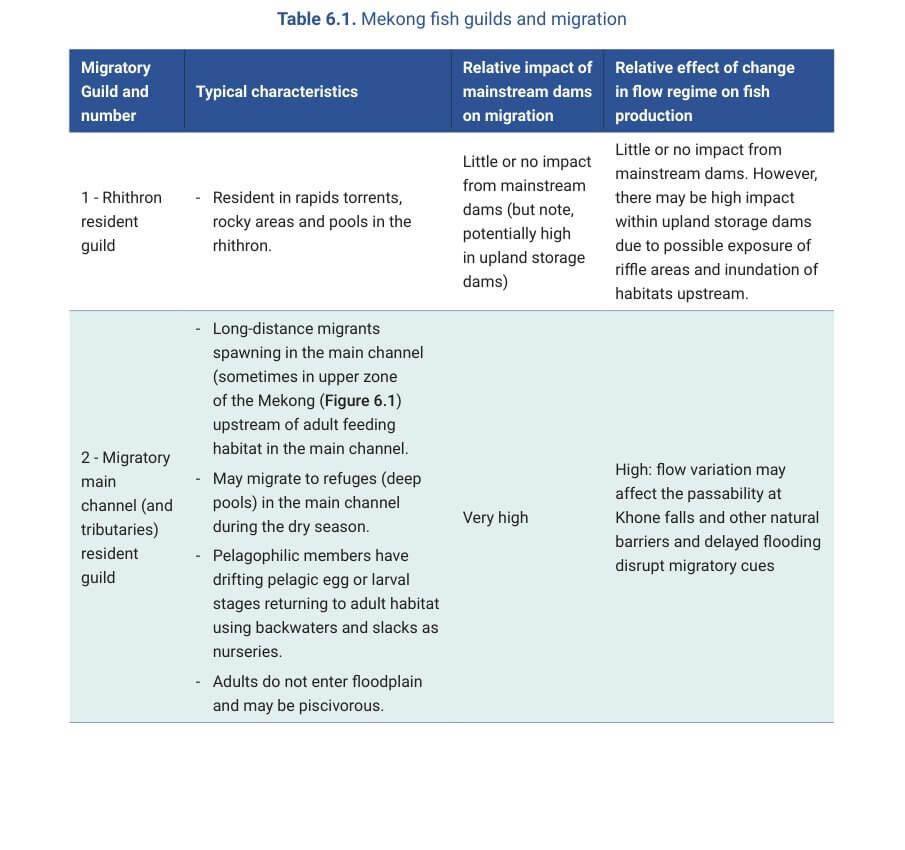
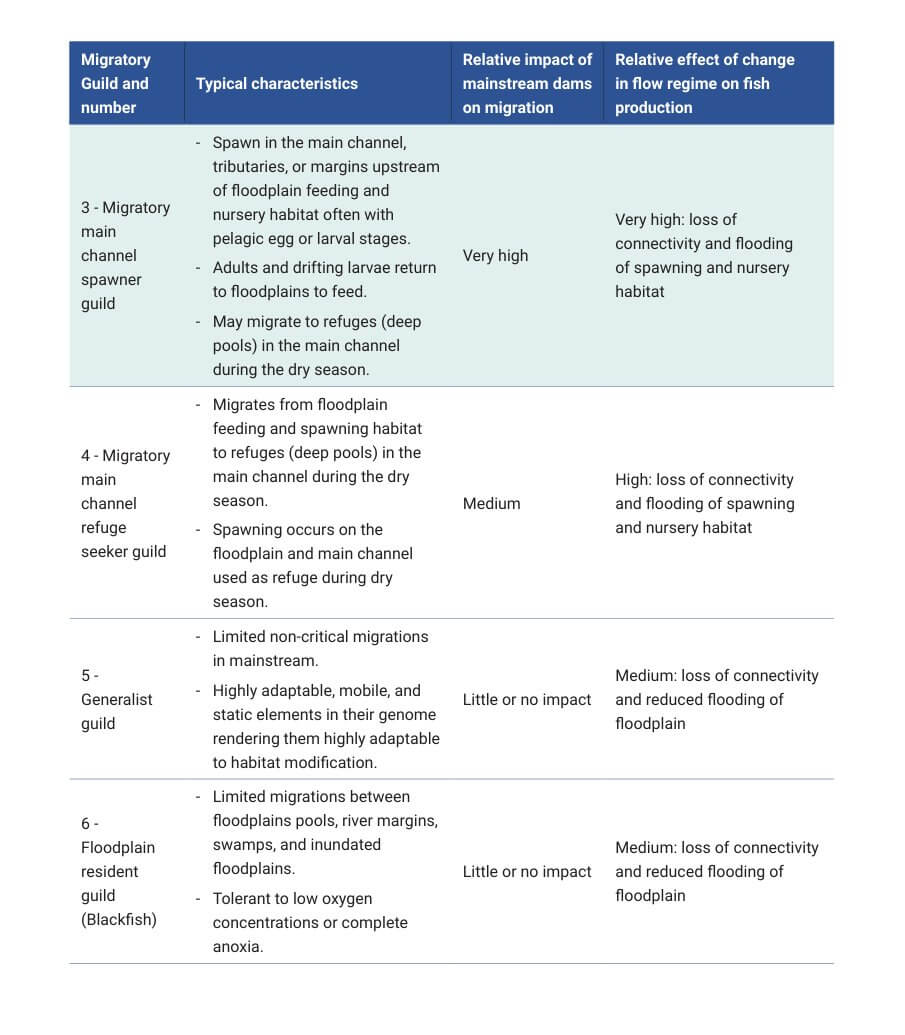
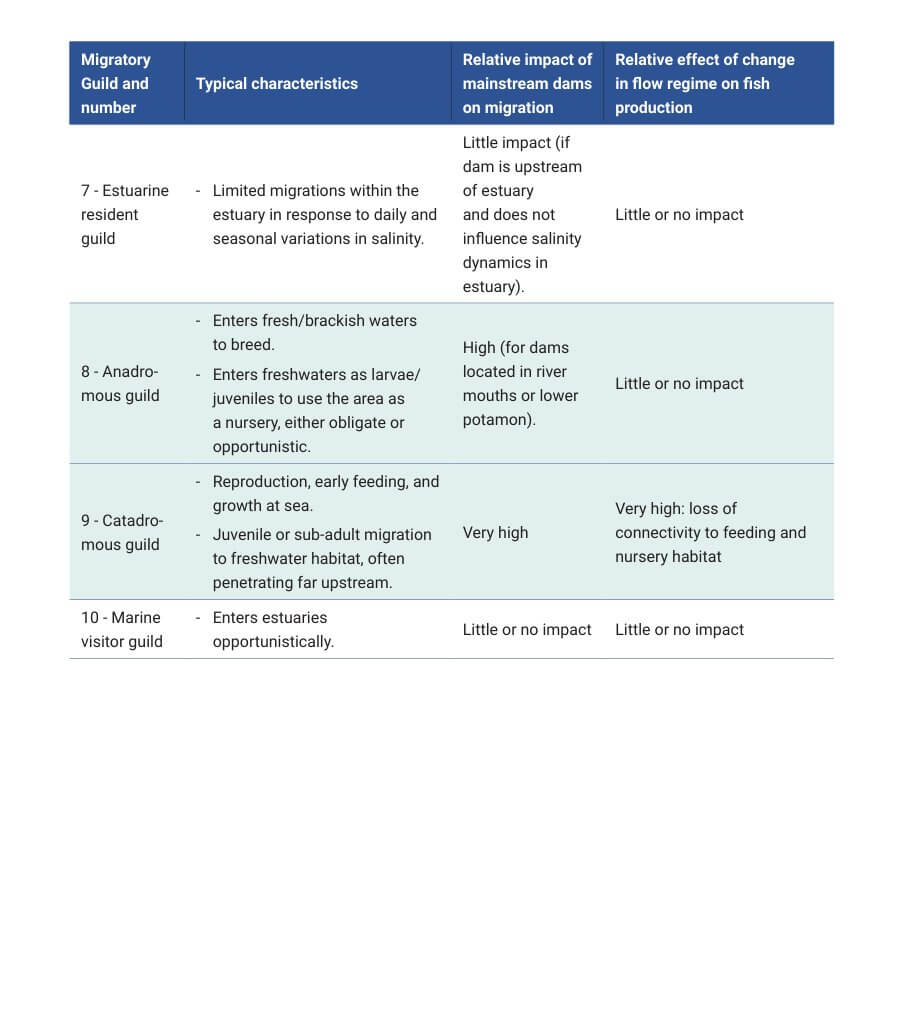
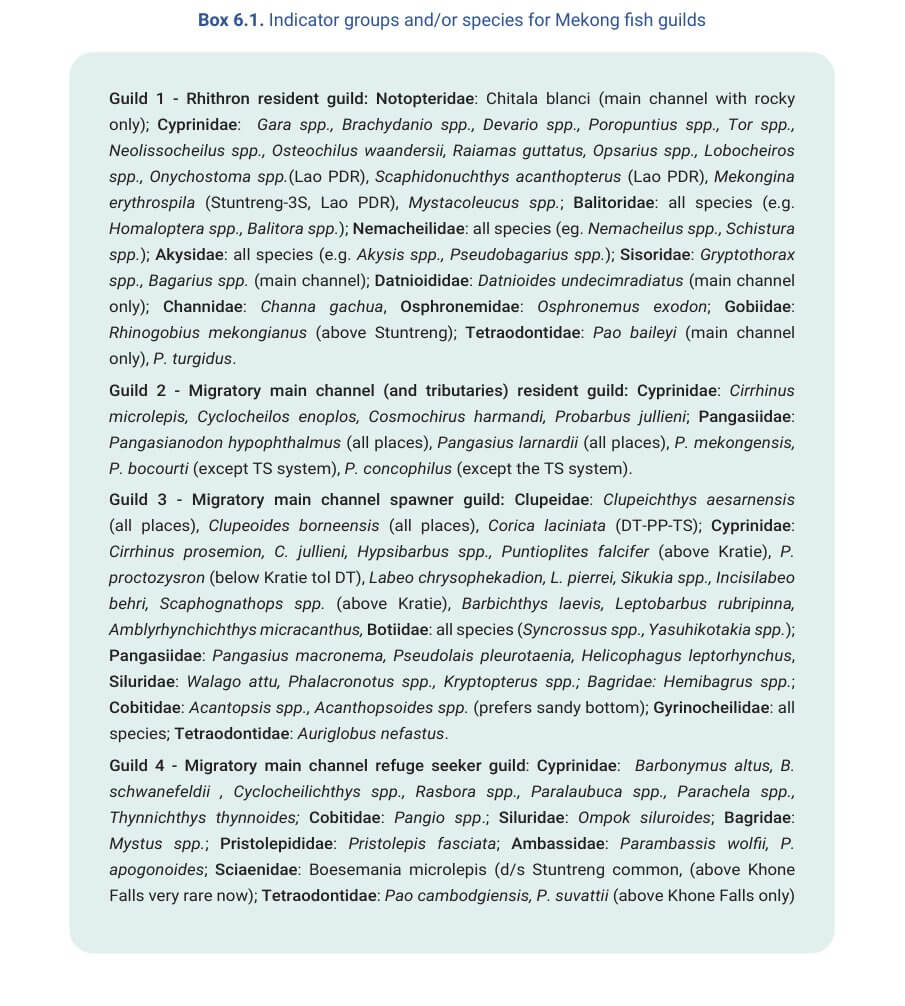
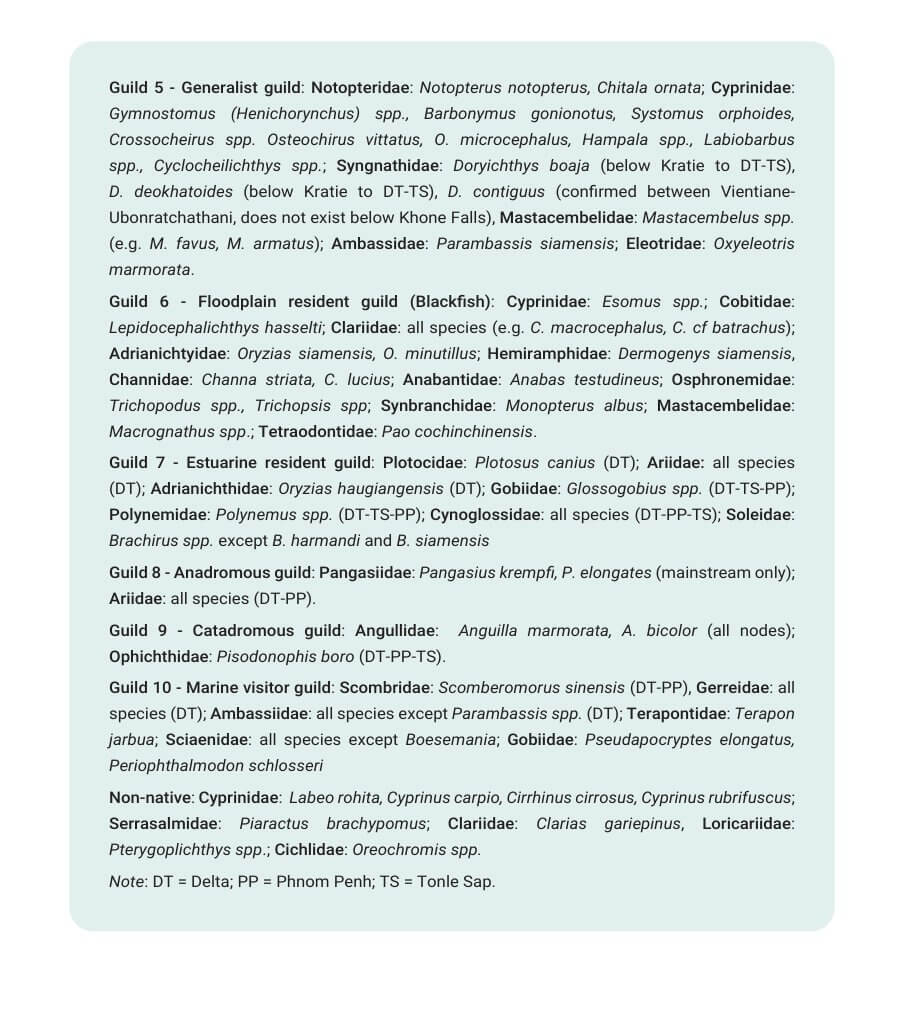
183. Potential risks to fish and fisheries, including OAAs, should be comprehensively assessed. Risks to fish and fisheries associated with hydropower development are summarized in Table 6.2 (see Table 5.2 for risks to OAAs) and are orientated around four major themes:
- Dams are physical barriers across rivers that interrupt fish migrations both upstream and downstream.
- Dams can change the river hydraulics from a flowing river (lotic) to a still water (lentic) habitat in the impoundment, which inundates spawning grounds, disrupts larval drift, can eliminate lotic-dependent native fishes, and creates a habitat that suits non-native species.
- Dams alter flow regimes (hydrology) in the downstream river, from run-of-river dams with lesser impact, to storage dams with high impacts by altering the seasonal timing and volume of flows.
- If the dam is associated with development of floodplains for other purposes, or if the floodplain is permanently inundated by the impoundment, floodplains can completely lose their function in the ecosystem, especially as feeding, spawning, and nursery areas.
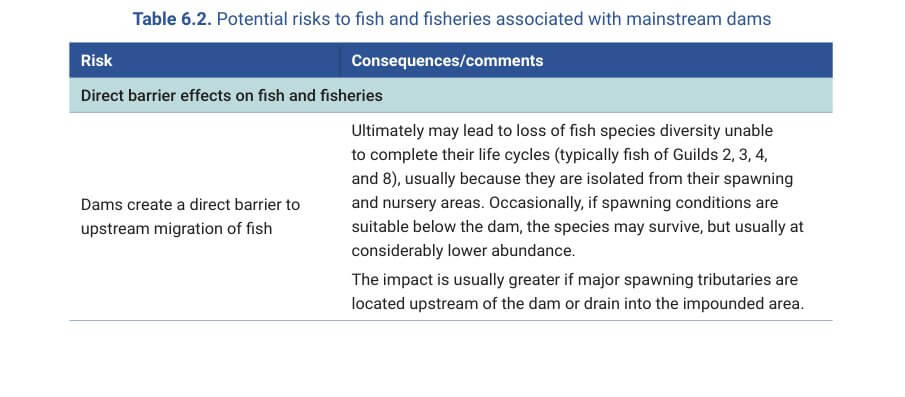
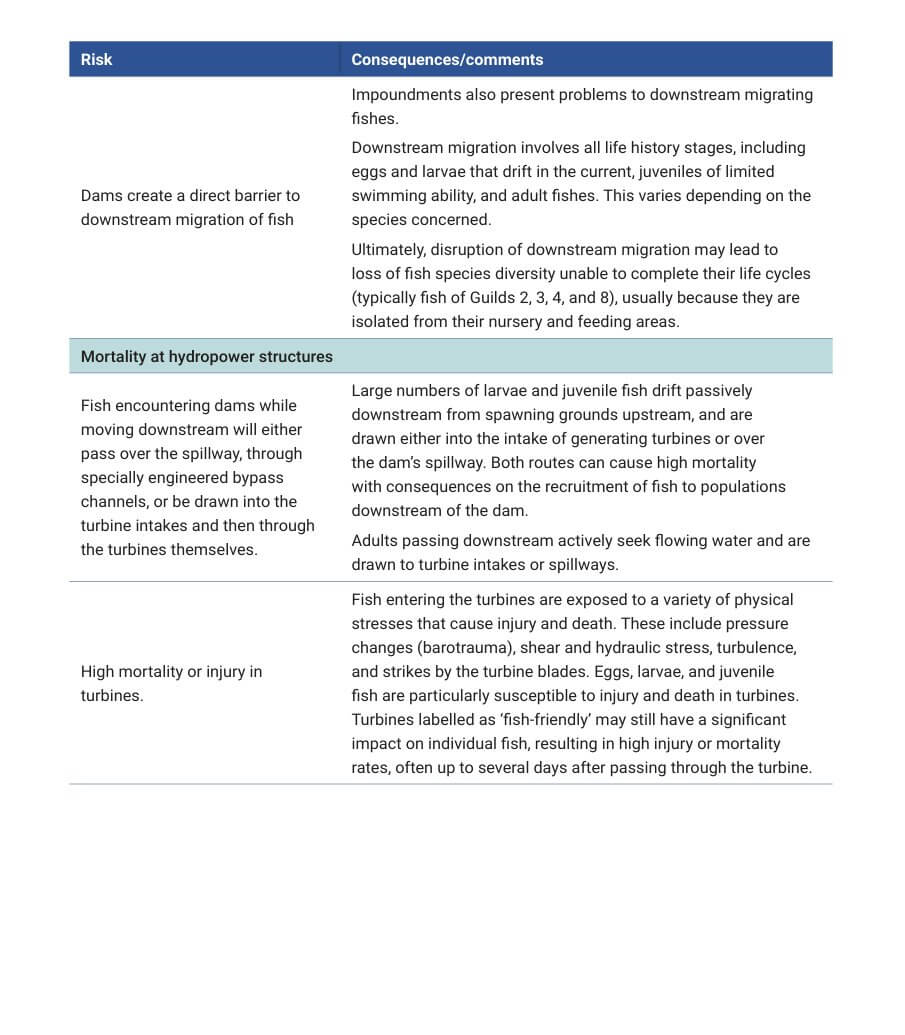
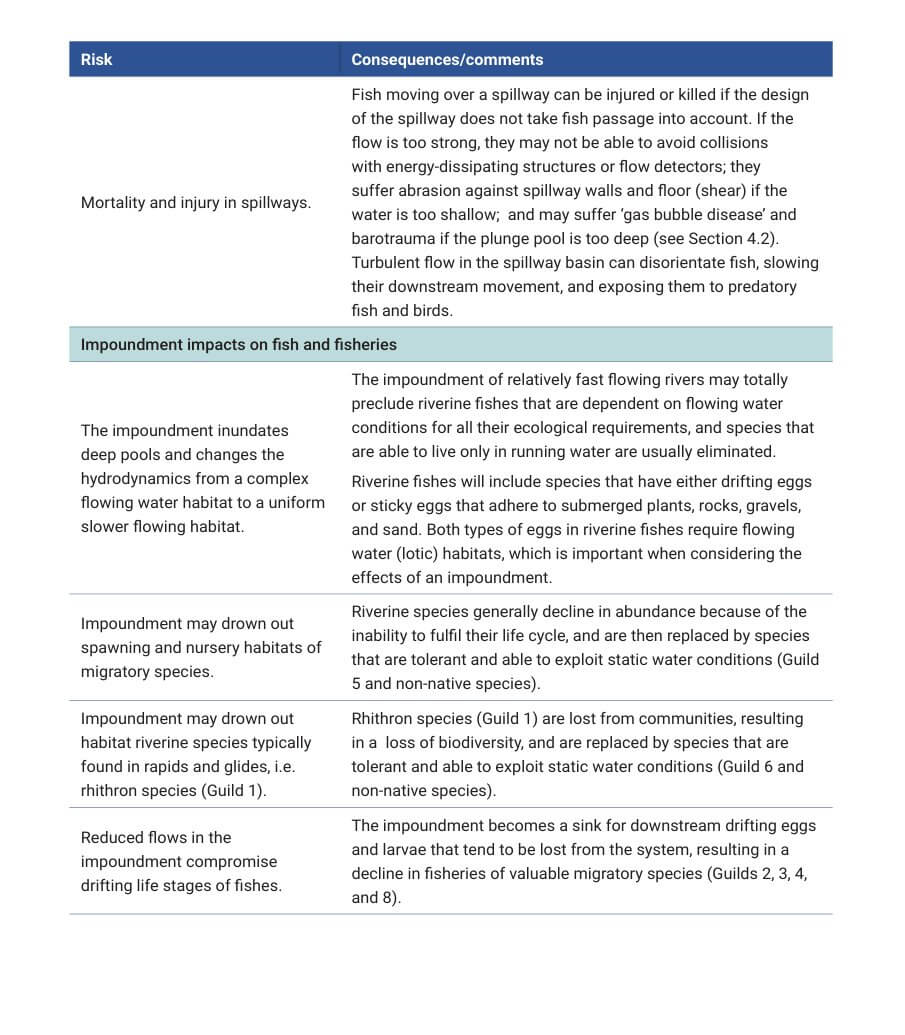
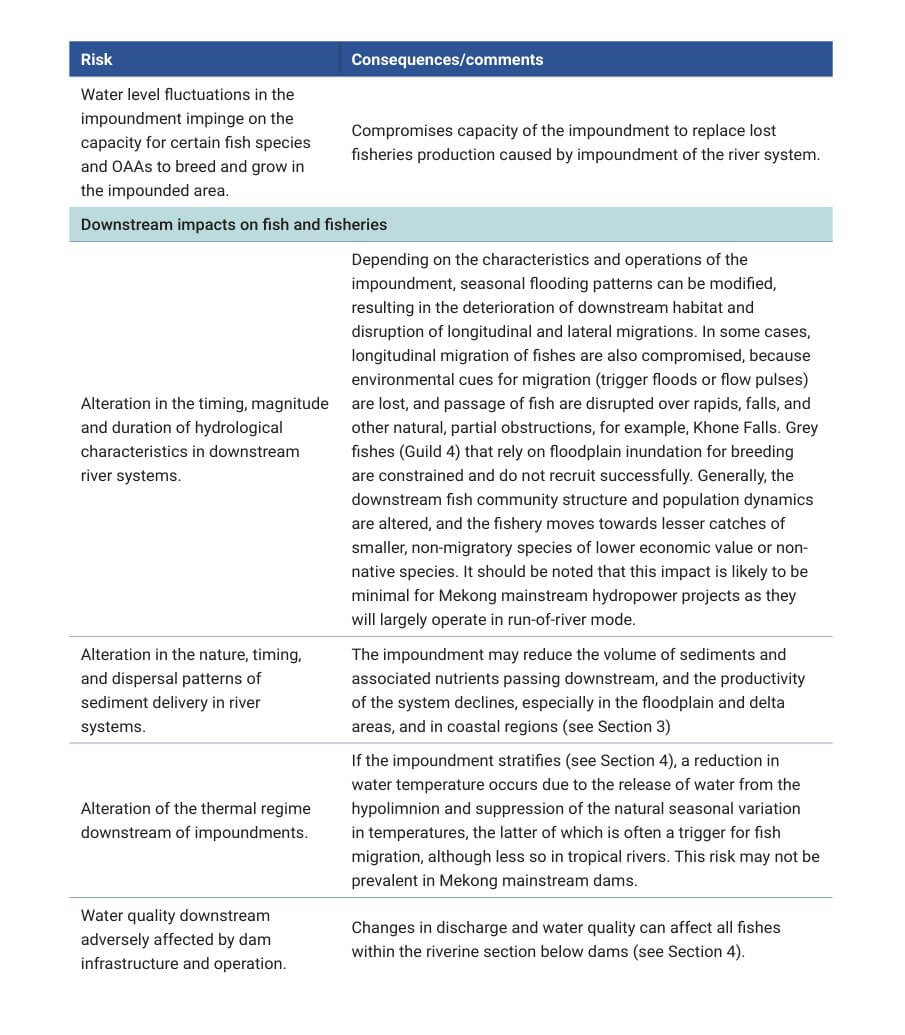
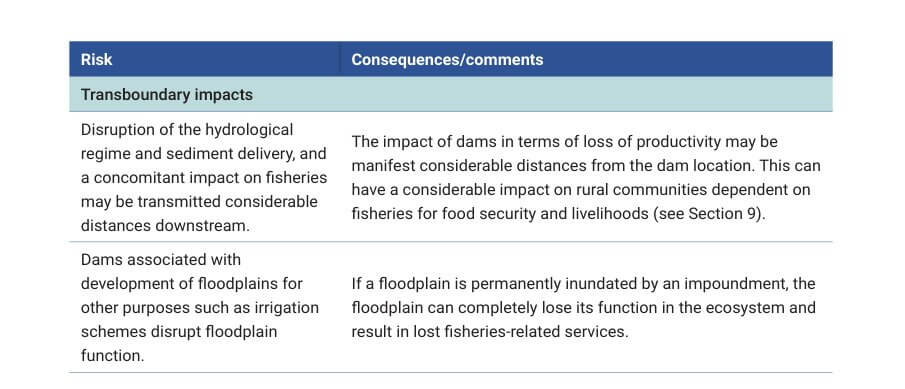
184. The different ecological guilds of Mekong fishes (Table 6.1 ) exhibit different levels of vulnerability to the effects of dams. The most vulnerable guilds are Guilds 2, 3, 4, 8, and 9, shaded in Table 6.1.
- The species that are most affected by the barrier effects of dams are short- and longdistance migrators (Guilds 2, 3, and 8).
- The species that are the most vulnerable to change in flooding patterns are: (i) floodplain spawning species (Guild 4) that move laterally onto floodplains to spawn and use the nutrient-rich floodplain habitat as a nursery area; and (ii) juvenile life stages of shortand long-distance migrators (Guilds 2 and 3), whose larvae drift onto the floodplain and also use this habitat as a nursery area.
- Species with drifting larval stages are mainly the riverine fish of Guilds 2, 3, 4, and 8. These require a minimum length of flowing water for drift that varies among species and is presently unknown for Mekong species. However, it is likely that at least 10 km is required for some short-distance migrants; more than 200 km for medium-distance migrants (Guilds 3 and 4); and over 1,000 km for long-distance migrants (Guilds 2 and 8). Drifting larvae need suitable nursery habitat to occupy and grow-on in the downstream course of their migration.
- Species that are only found in steep upland tributaries (Guild 1: rhithron species) will be unaffected by mainstream dams, but can be at risk from upland storage dams in tributaries, where there is inundation of habitats upstream and modification of flows downstream. These species are often endemic (only found in that location or river) to the region, have high biodiversity value as well as providing an important local food source. Fishes that only use floodplains (Guild 5: black fishes) are unlikely to be impacted unless floodplains are permanently inundated or disconnected and/or used for agriculture or urban development.
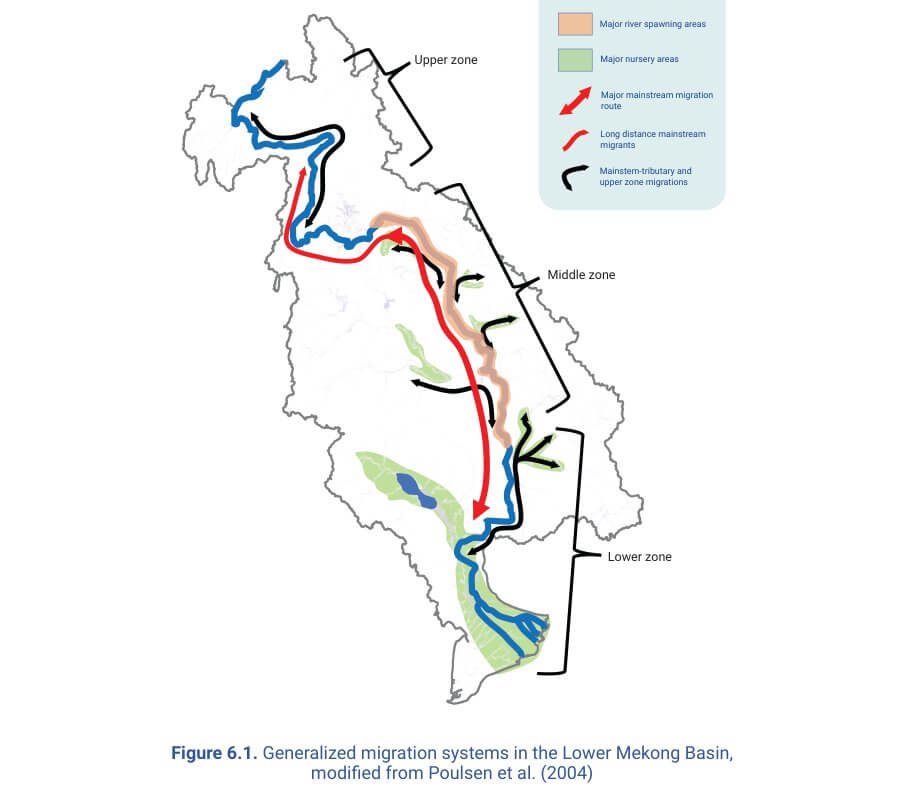
185. Many Mekong species exhibit complex life cycles that involve migration between different areas of the river (see Figure 6.1 ), particularly upstream migration to spawning areas, and downstream to nursery and feeding habitats. The timing of these upstream and downstream migrations is variable depending on fish life cycles. Spawning of different species in the Mekong system thus occurs across all seasons, but there are peaks during the spring (February–March), which is the most important time, followed by the onset of floods (June–July), and then when the water is receding (November).
186. The general understanding of migration patterns in the Mekong is that there are three main groupings in the upper, middle and lower LMB (Figure 6.1 ) with many commercially valuable species (possibly as many as 30 white fish species [Box 6.1 : Guilds 2, 3 and 8]) migrating long distances between these zones. There is spawning along the entire Mekong, but the middle and lower zones have significant floodplain nursery areas and spawning areas with major migrations between the two zones (Figure 6.1 ). Although many species migrate along the mainstream, they often spawn in tributaries, so the links between these two habitats are important.
187. The migratory fish resource at risk from dams varies in each of the three major zones of the river (Box 6.1). An indication of this variation is the commercial catch, which in the upper Mekong is up to 60,000 tonnes of fish captured per year, while the middle and lower zones are much higher annual catch rates of over 1.0 million tonnes of fish per year in each zone. Because of the high biomass of migratory fish in the middle and lower zones and the movement of fish between spawning and nursery habitats in each of these zones (F igure 6.1), there is much greater risk to fish populations when locating mainstream dams in these lower zones.
188. Because of the life cycles described above, a cascade of dams with sequential impoundments will eliminate most riverine fish species that require flowing water (lotic) habitats, even if fish passage is provided.
189. The monitoring approach for fish and fisheries presented in the PNPCA information should be sufficient to establish the baseline, to inform design, and to underpin project impact and mitigation effectiveness evaluations.
190. Key information to be submitted at the PNPCA stage is a fish species list grouped by guild (guided by Table 6.1 and Box 6.1) together with relative abundance, including those species observed and those expected to be present in the river system and conservation status of the species. A baseline needs to be established to identify species, size composition, and biomass requiring passage. Available MRC and other research data should be sourced for this purpose.
191. The following baseline data should be collated in conjunction with the list of species in Clause 182. Full use should be made of the MRC fisheries data and associated information in this assessment:
- the season of movement upstream and any hydrological triggers of migration (e.g. onset of flooding cycle) for the main species;
- the spatial distribution of spawning, nursery and refuge habitats for each guild within the region (200 km upstream and downstream of the proposed site, including the lower 50 km of tributaries);
- the scale of fish migration in terms of biomass of fish (based on independent studies and fish abundance and diversity monitoring) in relation to the seasonal flows, so these data can inform the design of fish passage facilities;
- the distance (spatial scale) of cyclic migrations of each guild;
- identification of fish species and OAAs that are dependent on flowing water (lotic) habitats for spawning and larvae drift, and the required minimum distance of larval drift to ensure successful recruitment;
- the contribution, species composition, and socio-economic value of fish and OAAs captured upstream and downstream of the dam site over the full flood cycle. These data enable an assessment of socio-economic impacts on local and regional livelihoods, food security, and economies, as well as informing biodiversity impacts.
192. Standard methods recommended by the MRC should be used, noting that they will be developed and updated over time, so that there will be consistent approaches by developers within the overall monitoring of fisheries in the river.
193. A list of threatened fish species or fish species of high conservation value near the dam and impoundment site, or potentially affected by the project, should be provided. An assessment of the potential impact of the development on the threatened fish species survival and actions to mitigate such impacts should be provided.
194. Drawing on the hydrological and hydraulic assessments 9 described in Section 2.3, the following information should inform selection of suitable fish passage options, develop concept designs, and assess effects on habitats and fish migration:
- daily and seasonal discharge linked with fish migration data to determine risks and inform fishway design;
- modelling results of the spillway and powerhouse operation, including sufficient 9 To assess the impact on fish and fish passage design, adequate analysis must be carried out and presented at PNPCA to allow MRC assessment of the effectiveness of the mitigation. Further detailed hydrological and hydraulic modelling may be undertaken during in the detailed design phase. assessment of potential hourly, daily and seasonal discharge, and upstream and downstream water levels; and spatial attenuation (distance affected downstream) of these variations;
- headwater and tailwater rating curves; and
- modelling results of daily and seasonal hydraulics, especially distribution of water velocity, of the impoundment to determine effects on lotic spawning habitats and larval drift.
195. Analyses of changes, impacts and mitigation options for fish, fisheries, and OAAs should identify the residual impacts and document where these will occur in the river, in line with Clauses 7 and 25.
196. Mitigation options should be evaluated to determine which ones will best address identified risks. Table 6.3 provides a summary of mitigation approaches that can be taken to address the broad categories of risk to fish and fisheries shown in Table 6.2 . A holistic set of mitigation measures should be implemented to address the multiple facets of change that affect fish and fisheries. Whilst only fish-related mitigation measures are addressed below, mitigation measures for flows, sediments, water quality and aquatic ecology in this Guidance are also important influences on outcomes for fish. The clauses following this table provide more specific guidance.
197. Given the lack of direct and experimental data on Mekong fishway efficacy, and the high consequence of risks to fish and fisheries, developers should engage the services of independent and knowledgeable fish passage experts with specific relevant regional and global experience early in the design process. Developers are encouraged to utilize available MRCS data, resources, and expertise at an early stage in line with Clause 16.
198. The following guidance for fish and fisheries is divided into two sections: habitats, which include planning of dam location and height, and operation; and fish passage, which provides for migration of fish upstream and downstream.
Habitats
199. As flowing water (lotic) habitats are key spawning areas and are essential for larval drift, dams should be sited and designed to maximize reaches with continuously flowing water.10 These flowing-water reaches are:
- preferably maintained within the entire impoundment by maintaining a mean channel velocity of > 0.3 m/s;
- between dams and the impoundment backwater (some species will likely require 10 km reaches, while others will require 200 km); and
- in tributaries. 10 It should be noted that the location of all mainstream dams is already determined based on engineering design requirements.
200. Dams should be sited and designed to avoid permanent inundation or disconnection of floodplains, which are key, usually irreplaceable, spawning and nursery habitats. Productive fish populations are dependent on the natural inundation and drying patterns of these habitats.
201. In dam operation, consideration should be given to managing river edge habitats (littoral zone) of rocks and vegetation downstream of the dam, especially during the onset of the wet season when many species will be spawning. Rapid water level rises are acceptable (but see Clause 71), but draw-downs of, for example, greater than 0.5 m per day (to be determined on a site-specific basis) in the spawning season could expose eggs. Migratory fish may congregate below a dam with inadequate or no fish passage, and often spawn in the area downstream of the dam.
202. Fluctuations in water levels in the impoundment can create a barren, unproductive littoral edge zone in the impoundment. Lagoon systems can be created in bay areas of the impoundment by installing small weirs, which buffer these fluctuations and maintain nursery areas in the impoundment during draw-down periods.
203. Fisheries production in impounded water bodies tends to decline 5-7 years after inundation. Traditionally, the inundated area is cleared of vegetation prior to flooding, but to support fisheries production in the impoundment, trees should be left unlogged in selected areas to provide increased surface area for periphyton growth, which acts as a primary food source for fish.
Fish passage
204. Fish passage facilities for both upstream and downstream migration should be incorporated into all dams on the Mekong mainstream. If fish passage is not considered viable to sustain populations (e.g. a cascade of dams is planned that eliminates flowing-water habitats upstream), then appropriate offset measures should be applied to compensate for potential ecological (biodiversity), social, food security, nutrition and economic (livelihoods) losses (MRC, 2018a).
205. Full effective mitigation to allow fish passage through Mekong mainstream hydropower projects has been shown to be up to 10% of the project capital cost depending on the project location and scale. This cost needs to be properly considered in the project financial model and business case.
206. Effective upstream and downstream fish passage should be evaluated using target species. These species should be based on commercial and livelihoods importance, broad coverage of ecological guilds, behaviour (e.g. surface, mid-water, bottom dwelling), size (small, medium, large), biodiversity value, and threatened species status.
207. Effective fish passage is defined in terms of a target percentage for the number of fish within each migratory species that approach the dam structure both upstream and downstream. Sub-samples are commonly used to assess these targets, not the whole population. Specific targets in this Guidance are based on what is required to meet the objectives stated in Section 6.1, i.e. continued population sustainability in the Mekong mainstream. They are not based on what has been proven successful for existing fish passage structures, noting that many existing tropical facilities globally have design and operational flaws that this Guidance seeks to address. The following fish passage targets are based on population modelling and passage rates of Mekong species and hydropower dams (Halls & Kshatriya, 2009)11:
- For long-distance migratory species (i.e. Guilds 2, 3, 4, and 8) at a single dam, large fishes (>75 cm) require more than 90% passage (of numbers of each species approaching the dam) and medium-sized (50–75 cm) fish require more than 80% passage. If there are multiple dams, more than 95% passage at each dam site is required for both size groups.
- Small, short-distance migratory species (Guild 4) moving between/along the river to floodplains require more than 60% passage (upstream and downstream) between spawning and feeding/refuge habitats.
- The above percentage passage requirements may be refined for the particular species concerned, based on its life history and the number of dams the species has to pass to complete its life cycle and as additional regional and site-specific information on these aspects becomes available. Biological and hydrological criteria for fish passage design
208. Flow range of fishway. The fishway needs to be designed to operate from minimum recorded flows to the 1-in-1 year annual recurrence interval (ARI) flow (63% annual exceedance probability). These flows need to consider climate change and flow regulation impacts from upstream, noting that an overestimate of minimum flows can prevent a fishway from operating.
209. Proportion of flow in fishway – upstream passage. A primary consideration (Williams et al, 2012) in the design of the hydropower project is ensuring that adequate flows are available 11 Note: the modelling is based on calculated mortality of fish through Kaplan turbines based on fish length, which may improve with new turbine designs, and also assumes that all larvae drift successfully through the impoundment and pass unharmed through the turbines. to attract fish to fish passage entrances. Adequate flows 12 must be directed through the fish passage to ensure they function effectively in both the high and low flow seasons, and at all times are sufficient to ensure optimal effectiveness to achieve fish passage targets in Clause 207. Flow allocation for fish passage should be based on local and international research (Armstrong et al., 2010; Bell, 1985; Larinier, 2002; Roscoe et al., 2011) with the basis of flow allocation clearly set out in PNPCA documentation.
210. Proportion of flow in fishway – downstream passage. Dedicated downstream passage facilities at the powerhouse require 2% of powerhouse flows to pass fish effectively. This target may be altered if more specific regional or site-specific data become available.
211. Considering the range of species, volume of migrations, and variation in flow conditions encountered at a dam site, each project should consider a range of different options for fish passage upstream and downstream. Multiple fishways at a single large site are also likely to be needed.
212. Unless more specific site/regional data are available, upstream and downstream fish passage facilities should ideally:
- operate all year as far as practical, within the flow range specified in Clause 208;
- pass migrating fish from 5 cm to 300 cm in length both upstream and downstream, as well as fish eggs and larvae drifting downstream; and
- pass the migratory biomass of the Mekong River as determined during baseline monitoring and external assessment activities, noting that this is very high, especially in the middle and lower zones of the Mekong (i.e. approximately downstream of Vientiane, Figure 6.1). Upstream fish passage
213. An upstream fish passage has two separate design components: 12 Research indicates that a primary consideration in the design of a hydropower project is providing sufficient flow at the fishway entrance to attract fish from the river into the fishway. At low flows (defined as the flow exceeded 95% of the time, or Q95 of present flows), 10% of the flow is required for effective fish attraction into the fishway. At the upper flow range for the fishway (1-in-1 year ARI), allocation of 10% of flow for upstream fish passage is desirable, but 2% would be a minimum. This flow can be a combination of passage flow (along the entire fishway) and auxiliary flow (additional flow) in the lower section of the fishway, but excludes attraction flow external to the fishway entrances(s). At very high biomass sites (e.g. downstream of Vientiane), half of the flow allocation is needed for passage flow along the entire fishway. At large hydropower dams that have effective fish passage, allocating 10% of the minimum river flow for fish upstream passage is a common standard (although 30% can be used); 5% of maximum turbine discharge has also been used. As an example, publicly available information states that the Xayaburi Dam fishway on the Mekong River provides a fishway attraction discharge of 8.6% (86 m3/s) of low flows (Q95); 5% (240 m3/s) of the maximum turbine discharge (5,000 m3/s); and 2.5% of high flows (10,000 m3/s). Research will test whether these flows are adequate. These targets may be altered if more specific regional or site-specific data become available. They also do not apply to small streams or tributaries, where fishways can potentially use 100% of flow.
- Attraction – in terms of fish approaching the dam and locating the entrance(s); and
- Passage – through the fishways.
Attraction
214. To achieve effective attraction, fish passage design should be integrated into the earliest project concepts, because it influences the dam axis alignment, dam and powerhouse configuration and alignment, abutment, and training wall shapes, spillway and gate design, and stilling basin design.
215. Physical modelling at an appropriate 13 scale should be undertaken during detailed design to accurately predict flow patterns and achieve functional fishway entrance conditions (see Clause 24). Modelling should include the spillway, powerhouse, fishway entrances (with auxiliary and attraction flows), and downstream river channel conditions. Separate models may be needed of different dam components because of size limitations. Modelling should test the full range of fishway flows, as above, to ensure fish can locate and access entrances. Fishway entrance design and integrating it with dam design, can occur before any fishway channel design.
216. 3D computer modelling (Computational Fluid Dynamics, or CFD) is also useful when used in conjunction with physical modelling.
217. The key design principles in physical/computer modelling to optimize fish attraction are:
- Create continuous paths and refuges of low water velocity and turbulence that lead to an “upstream limit of migration”, which is delineated by high water velocities without refuge (e.g. at the toe of spillways) and high turbulence without refuge. Fish are attracted to the greatest discharge (turbines or spillway), and utilize low water velocities adjacent to high discharge and high-water velocities to migrate upstream.
- Minimize recirculating flows (horizontally or vertically) and cross-flows, which trap and delay migrating fish.
218. Multiple entrances should be provided at large dams and at sites with variable discharge. Migratory fish will be attracted to a wide area, and the “upstream limit of migration” will vary with discharge.
219. Fishway entrances should accommodate fish species that will use surface, midwater, and benthic zones and the thalweg (deepest channel). The thalweg needs to lead to the fishway entrance; the river channel may need reshaping during construction to achieve this.
220. Spillways and discharge gates should be designed and operated so that flows initiate and 13 The appropriate scale will depend on the size and geometry of the dam and river reach. For example, physical modelling for Xayabury was undertaken at an undistorted linear scale ratio of 1: 120. The scale should allow sufficiently accurate assessment of fish passage approach hydraulics. terminate adjacent to the fishway entrance(s) to maximize attraction to the fishways.
221. All spillway flow can be used for fish passage, noting that fish migrate during all seasons and under all flow conditions.
Passage
222. Design options for upstream passage at high dams or dams with large discharge include, but are not limited to:
- Large pool-type fishways
- Large nature-like bypass channels
- Fish locks
- Fish lifts.
223. Within upstream fishways, the following criteria may be used, unless more site-specific data becomes available:
- Maximum water velocity for short distances (< 0.2 m; e.g. in vena contracta of slot or orifice) is 1.4 m/s.
- Maximum water velocity in channels is 0.5 m/s.
- The maximum turbulence in a fishway pool is 40 Watts per cubic metre (calculated using a discharge coefficient of 0.7).
- Minimum depth is 3 m under all flows, or equal to the maximum natural channel depth (thalweg) at low flows.
- Pool length and width should be at least three times the maximum length of the largest fish.
224. Fish passage facilities should pass the peak biomass, which requires the appropriate sizing of fishways, and suitable cycle times of fish locks and fish lifts.
225. Predation within the fishways should be minimized. Adequate shelter for smaller species while within the confines of the fishways should be considered, and residence time in the fishways should be minimized.
226. Water quality should be maintained within any holding enclosures to ensure fish health. Oxygen levels should be maintained within the fishways at >5 ppm (e.g. fish lifts).
227. Fishway designs should be flexible and adaptable, and have redundancy. For example, baffle shapes may be adjustable or have adjustable inserts, and mechanisms of water release for fish attraction and passage flows be adjustable over time. Feedback from monitoring and observation of fish behaviour should lead to optimization of the fishway operation.
228. If cyclic fish passage is used, such as fish lifts or locks, the period of captivity and interruption to the normal movements of the fish should be as short as possible.
229. Fish exiting upstream fishways should not be drawn back over the spillway during overtopping. Exit conditions should be sufficient to provide a stimulus for fish to exit the fishway. The combination of suitable attraction flows, substrate, and protection from predators is important.
230. Fish exiting fishways both upstream and downstream should be sufficiently healthy to continue their natural patterns and migration routes. Direct and indirect mortality combined, as a result of movement through the dam, impoundment, and fishways, should be in line with the objectives (Clause 207) for the relevant guild.
231. If feasible, navigation locks should be designed for fish passage (see Clause 322). Specific modifications are required for passing fish, including providing attraction flows and additional entrance(s) for migratory fish near the upstream limit of attraction. These aspects affect the design of gates, valves and dissipators. Downstream fish passage
232. Downstream passage includes:
- larval drift through the impoundment;
- passage at the fish screens/trash racks;
- turbine passage of fish that pass through the fish screen; and
- passage through the spillway gates.
233. A mean channel velocity of > 0.3 m/s for the entire length of the impoundment should be provided to maintain larval drift through the impoundment for migratory species (Guilds 2, 3, 4, 8). This requirement should be part of the initial scoping investigations and design, because it is easier to achieve in a narrower river channel or a lower height dam.
234. Fish screens should be designed to guide downstream-moving fish away from turbines and towards downstream fish passage facilities, which may be a shared facility with upstream fish passage. Fish that pass through the screen will pass through the turbines; hence, the internal spacing of fish screens should be linked with the extent that the turbine design passes fish safely. Coarser mesh screens may be used if the turbine can safely pass larger fish, while finer mesh screens should be used if the turbines cannot safely pass small fish. Alternative methods to screening may be used, if these are shown to be effective through regional or site-specific research.14
235. Fish screens at high discharge sites (e.g. 2,000 to 5,000 m³/s) such as the mainstream 14 Where high debris load or a deep thalweg make suitable screens unfeasible, alternative solutions may be needed to divert larger fish, which cannot safely pass through turbines, away from the turbine intake. Mekong may divert large and medium-bodied fish, but are unlikely to divert small fish and larvae, so turbines should be designed to pass these smaller fish.
236. Screens should be angled at least 45 degrees to the current and have a surface velocity less than 0.5 m/s to prevent impingement, unless testing shows different criteria or screen designs that will divert fish safely.
237. Self-cleaning screens should be installed where there are high debris loads.
238. For small/medium fish that pass through the fish screens, turbines should be designed to have the following criteria, unless more site-specific data becomes available:
- To minimize blade strike, the leading-edge width of the turbine blade should be equal to the length of the largest fish passing through the screens.
- Shear should be less than 150 cm/s/cm for 99% of exposure paths.
- To minimize impacts from sudden pressure changes (barotrauma), the pressure change ratio should be < 0.1.
- The turbine design and placement should factor in these needs, because they may not be met based on considerations solely for hydropower generation. For example, to achieve a pressure ratio < 0.1, the turbines are likely to need to be deeper in the tailwater, which requires further excavation than may be planned for only hydropower generation needs.
239. At detailed design stage, a computational fluid dynamics model should be used to assess the extent of the above values and the exposure paths of fish through the turbine.
240. Species with a similar size and swim bladder morphology compared with Mekong fish should be used to assess mortality through turbines.
241. Spillways, aprons, stilling basins, and dissipater design should be designed to minimize fish injury, noting that total mortality should be less than 5% for many species.
242. If feasible, gates on spillways should be overshot, or designed to be used fully lifted, because undershot gates have high pressure changes and shear values that kill fish. Fish passage operation
243. Capture fisheries in the vicinity of the fishways should be managed to ensure that mortality caused by fishing is not excessive. No fishing should be allowed within 500 m of the fishway entries or exits, or within the fishways.
244. Where ecological objectives downstream of the dam are to be met through the discharge operating rules, any releases that do not pass through the turbines should be directed through the fishway as a first priority, thereby ensuring that fish are attracted to the fishway entrance as well as maximizing operating time.
245. Where practical, hydrological conditions should be maintained to ensure that migratory fish species can access tributaries and floodplains downstream of the dam and floodplains on the perimeter of the impoundment. Fish passage during construction
246. Fish passage should be provided during construction, based on an assessment of the migratory population approaching the site and the proportion of each target species that passes through. Navigation locks may form part of this solution. Alternative mitigation measures and fisheries resource management offsets
247. Where fish passage rates are unlikely to be adequate to maintain viable regional fish stocks, or local fish populations are not maintained, the developers should consider support measures including offsets for lost fisheries and OAA resources. From a fish and fisheries perspective, the following technical inputs should be considered in relation to any alternative measures. The livelihood aspects of support measures and offsets are addressed in Section 9, as follows:
- Offsets should move beyond traditional approaches of fish farming and stocking fish and OAAs (mainly prawns), because these rarely replace the loss of fish stocks and OAAs (and hence catches), and should be used in conjunction with other measures.
- Aquaculture (cage culture) within the impoundment of a mainstream dam would be reliant on stable water levels and low water velocities at high flows, because fluctuating water levels and high flows make anchoring and access problematic. Non-native species (e.g. carp and tilapia) should not be grown in the cages, because there is a high likelihood of escape and proliferation of non-native species in the wild to the detriment of native species.
- Stocking of indigenous fish and OAA species in the impoundment would require continuous stocking through the life of the project. The production from stocking will not, however, replace the lost wild fisheries and OAA yield due to the decline in impoundment productivity after 5–7 years. Also, the short retention time of water in the mainstream dams prevents the build-up of primary productivity.
- Small fishways could be built on wetlands to reconnect nursery areas with river habitats.
- Re-creation of wetland habitats to support recruitment to wild capture fisheries and OAAs, or creation of new fisheries that have been lost due to the dam and impoundment could potentially be achieved within the impoundment by creating lagoon wetlands, or upstream or downstream of the project by reconnecting wetlands or floodplains lost to agriculture.
248. Plans for project monitoring of fish, fisheries, and OAAs should take into account the guidance in Clause 26. The PNPCA information should demonstrate that plans for fish, fisheries and OAA monitoring information to be collected during construction and operation will inform:
- developers’ needs regarding fish passage management operations; and
- indicators that may signal a need for adaptive management responses to fish, fisheries and OAA-related mitigation measures.
249. The monitoring programme commenced for the pre-project assessments (Section 6.3) should be continued during the construction and operation stages, and adapted where needed to better inform construction and operational stage information requirements for management. Components of the overall fish and fisheries project monitoring programme should consider the status of fisheries and biodiversity (including OAAs), fish passage effectiveness, and fish and OAA habitats.
250. Focal areas for annual review based on quantitative assessments should be:
- For the upstream fish passage: the effectiveness of: fish attraction (locating the entrance); fish passage (through the fishway); and safe exit. Appropriate scientifically proven methods to assess the effectiveness fish attraction and safe exit should be adopted.
- For the downstream fish passage: larval drift in the impoundment; the efficiency of fish screens and fish bypasses; fish passage through turbines; and fish passage through gates and spillways. Appropriate scientifically proven methods to assess larval drift should be adopted.
251. The monitoring plan presented at the PNPCA stage should show how the proportions of the numbers of fish of each target migratory species (three species of each migratory guild, preferably including benthic, pelagic and surface-dwelling species), and the total biomass that are able to pass the dam successfully both upstream and downstream will be determined and compared to the targets in Clause 207. The proportion of fish represents fish approaching the dam at the time of sampling, hence, is robust to other changes in fish populations that may occur due to other catchment impacts. Mortality levels of individual species should also be estimated, as per Clause 241.
252. If actual percentages passing the dam are lower than the targets, a review of the facilities and operations against the recommendations in this Guidance should be made, and actions implemented to improve the fish passage arrangements, as per Clause 27.
253. Monitoring of habitats and spawning activity in littoral zones downstream of the dam should be included in the overall monitoring plan. Findings can inform any refinements in operating rules (sediment flushing and flood control) that may then maximize fish recruitment and populations downstream.
254. In addition to recommendations for overall water quality monitoring for the project (Section 4.5), specific water quality monitoring should be undertaken in the fishways to inform if there are any water quality-related issues that may have implications for effectiveness. Parameters should include water temperature and dissolved oxygen.
255. Standard methods as prescribed by the MRC are recommended to be used to ensure robust data and analysis, and consistent approaches by developers with the overall monitoring in the river. Opportunities for collaborative approaches among projects on the mainstream should be considered if possible (e.g. by using the same PIT tag system for detecting tagged fish).
Use the interactive database below to search, filter, and download formal guidance documents, technical papers, and checklists for this topic.
| Title | Date | Type | Size | Link |
|---|---|---|---|---|
| Roscoe, D., (2011). Fishway_passage_ | 2026/09/09 | 184 KB | Download | |
| Poulsen, A. F. (2004) | 2026/09/09 | 5.4 MB | Download | |
| MRC (2018a) Guidelines for hydropower | 2026/09/09 | 13.5 MB | Download | |
| Larinier, M | 2026/09/09 | 16.1 MB | Download | |
| Halls, A., & Kshatriya M. (2009) | 2026/09/09 | 7.4 MB | Download | |
| A Fish Passage Problem at the Seton Hydroelectric Project | 2026/09/09 | 659 KB | Download | |
| Armstrong, G., Aprahamian | 2026/09/09 | 9.5 MB | Download |
Use the interactive database below to search, filter, and download formal guidance documents, technical papers, and checklists for this topic.
| Title | Date | Type | Size | Link |
|---|
Use the interactive database below to search, filter, and download formal guidance documents, technical papers, and checklists for this topic.