
Navigation
This topic addresses the river's role as a transport corridor, and the need to keep it navigable where navigation exists or is planned.
Download this section (PDF)
Key objectives
- Maintain safe navigability and river connectivity for vessels where navigation is present or foreseen.
- Provide navigation locks or equivalent facilities where required.
- Avoid obstructing existing and future navigation, in coordination with relevant authorities.
What the guidance addresses
The guidance covers navigation-lock provision, safe passage arrangements, and coordination with national and regional navigation planning.
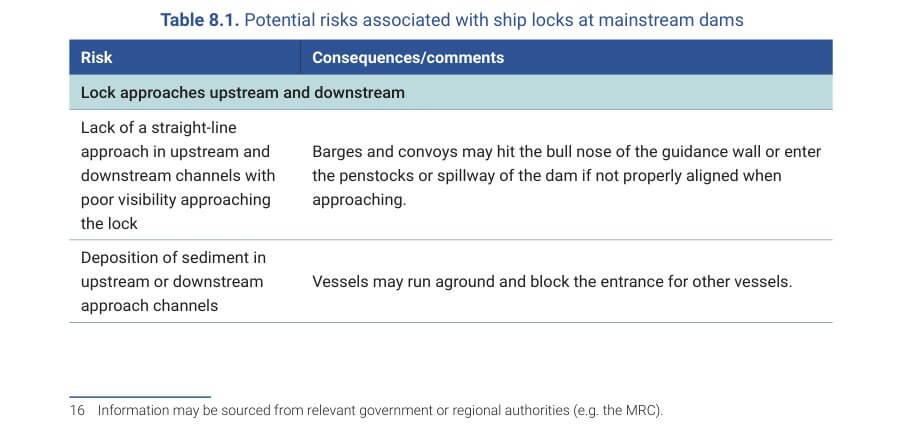
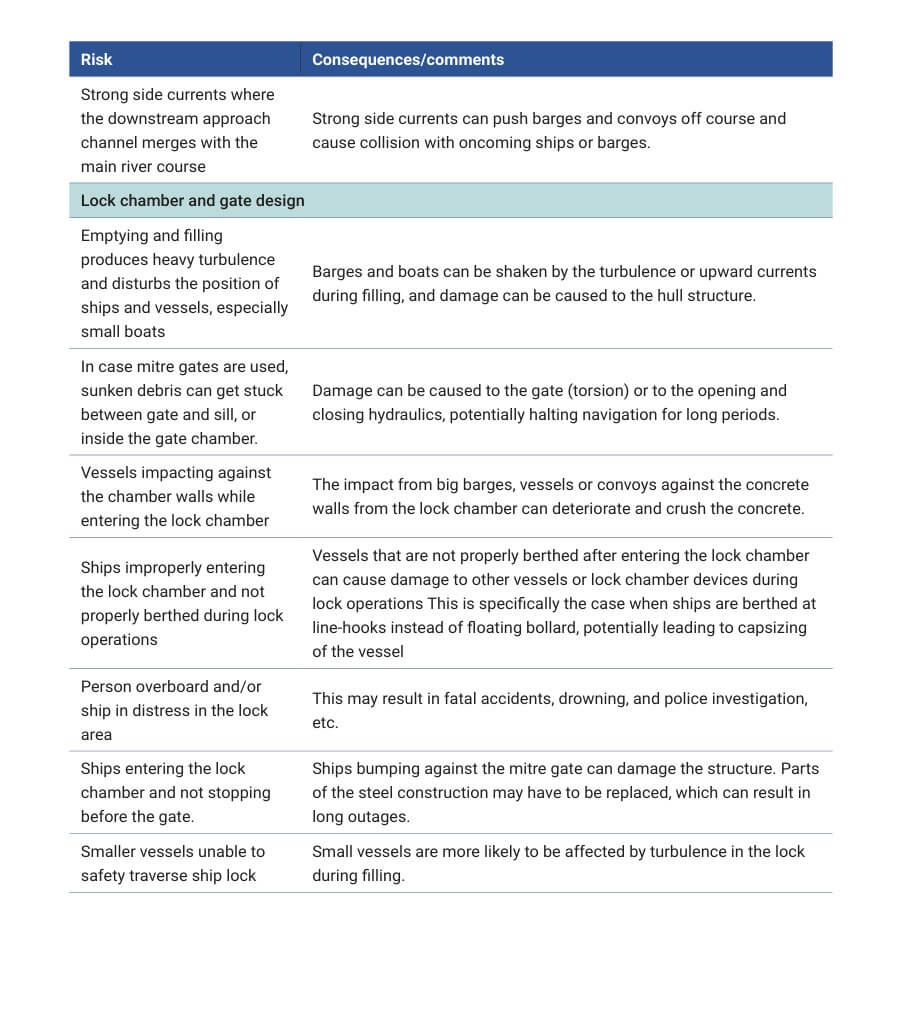
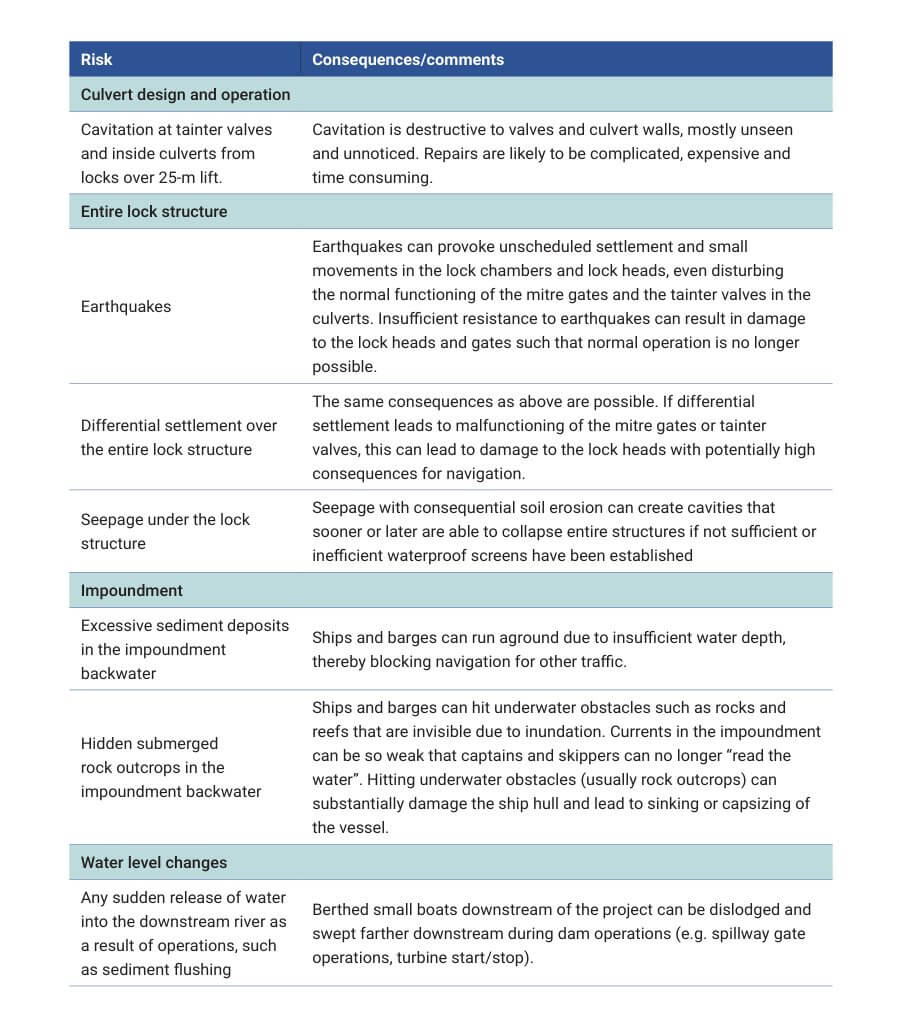
297. Risks associated with navigation should be comprehensively assessed. The PNPCA documentation should indicate how the design has dealt with the potential risks associated with navigation, and in particular with the ship lock, as shown in Table 8.1.
304. An essential guide for many of the design aspects for the mainstream Mekong ship locks is the 2009 Permanent International Association of Navigation Congresses (PIANC 17 report). Innovations in Navigation Lock Design; and an essential guide for Mekong navigation is the PIANC InCom WG report n⁰ 141-2019, Design Guidelines for Inland Waterway Dimensions. It is the developer’s responsibility to obtain these guidance documents through the PIANC procedures. This Preliminary Design Guidance (PDG) directs the user to specific sections of these PIANC reference documents for important design requirements.
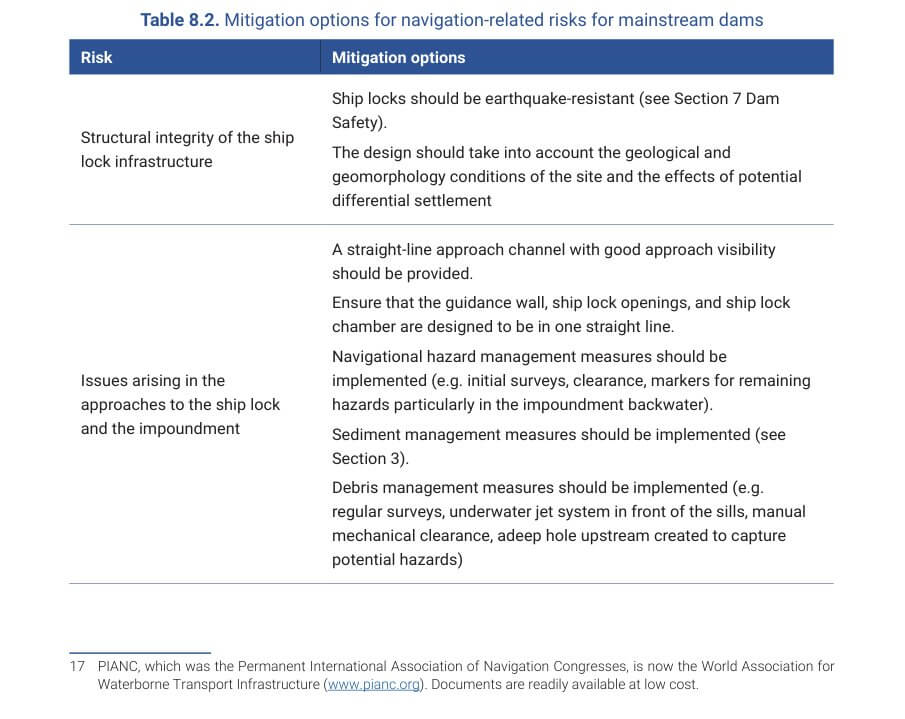
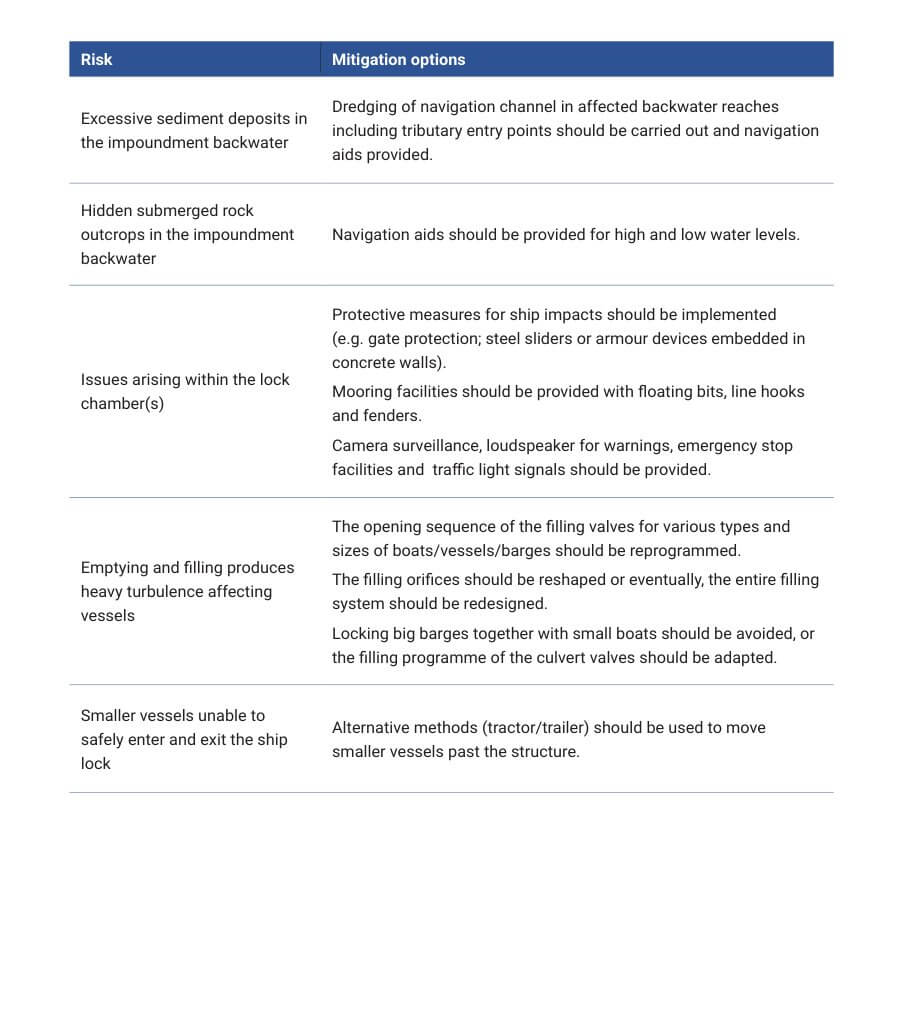
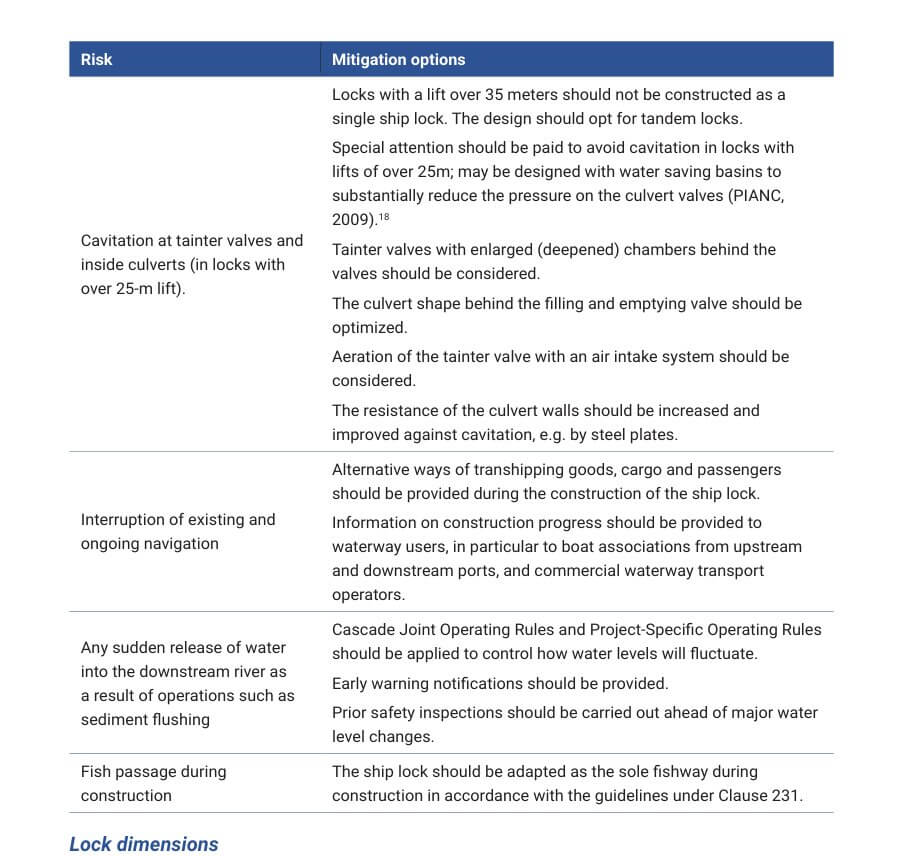
305. Mitigation options should be evaluated to determine which ones will best address identified risks. Table 8.2 sets out mitigation options for the broad areas of risk, with more detailed guidance provided in the clauses following this table. Developers may propose alternative mitigation options based on the specific site location and associated risks with appropriate justification.
Lock dimensions
306. Lock dimensions have been decided for all navigation locks to be constructed along mainstream dams, following the outcome of the Optimisation Study of the Mekong Mainstream Hydropower Projects commissioned by the Government of Lao PDR. Ship 18 PIANC-InCom report from working group 29 (Report n⁰ 106-2009): “Innovations in navigation lock design”, Section 4.4.5 (p. 82). lock chamber dimensions should be at least 120 m x 12 m x 4 m, which comfortably accommodates a convoy of two 500-t barges (Chinese design) with pusher vessel.
307. The Mekong/Lancang River upstream of the Khone Falls should be considered as a single navigation unit using the above ship and lock dimensions. Downstream of the Khone Falls (Cambodia – Viet Nam), different ship lock dimensions may be applied since this is another separate navigation unit with potential connection to the sea. Lockage time and availability
308. Lockage time should be kept to the minimum whilst allowing for safe operations and safe movement of all vessels in the lock chamber(s) and should be guided by PIANC recommendations.19
309. The design criterion for hawser forces in all possible directions should be ≤ 1% x water displacement of the vessel (in tonnes) and should be guided by PIANC recommendations.20
310. The locks should be designed to operate at least 12 hours a day, every day of the year.
311. Each lock complex should be operational for at least 98% of its scheduled operating time during each year of its service life, excluding planned closures for scheduled maintenance and unscheduled repairs.
312. Outages related to incidental breakdowns should not exceed 2 percent of the operating time each year.
313. Service outages for scheduled maintenance should be on nine consecutive days (one working week and the two weekends) each year, during the same period for all dams on the Mekong mainstream waterway (upstream of Khone Falls) to avoid traffic disruption. This period should be established in the Cascade Joint Operating Rules. The official body in charge of navigation coordination along the Mekong River should be responsible for specifying the dates for servicing.
Approach infrastructure
314. Approach infrastructure should be designed in accordance with PIANC recommendations.21 Three different berthing areas should be provided, each able to berth one full-sized design vessel/convoy, and include the following:
- a lay-by area where ships can be ready to immediately enter the ship lock as soon as the preceding vessel has left it or the green entry light is turned on;
- a waiting area where ships can wait if there are several others ahead of them. The 19 See PIANC (2009), Chapter 4.2.5 Duration of Lock Cycle and Vessel Passage (p. 56). 20 See PIANC (2009), Chapter 5.2.3 Mooring Line/Hawser Forces during Filling and Emptying of Lock Chamber (p. 109). 21 See PIANC (2009), Chapter 5.6 Lock Approach Structures (p. 148). waiting area can be an extension of the lay-by area;
- the overnight area where ships and vessels can spend the night. The overnight area does not necessarily have to be connected to the lay-by or waiting areas, but all three areas should have access to land via a catwalk or via floating pontoons. The overnight area may be developed at a later date if demand is low at the time of project commissioning, and plans submitted at the PNPCA stage should indicate if this is the case and how it has been provided for; and
- one of the above three areas may provide facilities such as potable water, clean water, solid and liquid waste facilities, emergency aid, etc.
Service life
315. Each lock complex should be designed for a functional lifetime of 100 years.
316. Some components of the lock may have a service life shorter than 50 years. These components are listed below and should be designed to allow for easy replacement.
- Metal structures
- Hydraulic jacks
- Ball bearings, pulleys, joints, valves, etc.
- Cables
- Electrical equipment
- Communication and digital safety equipment, cameras, and TV sets.
317. Sufficient spare parts should be obtained during project implementation for the most vital mechanical parts of the ship lock. Guidance on life cycle management for locks is provided in the PIANC reference.22
Future expansion
318. The design of the locks system should allow for future construction of a second line of locks.
319. The owner/operator should be responsible for the construction of a second line of parallel locks when the number of lockages per year reaches at least 80 percent of the total maximum possible yearly lockages over a period of two successive years. 22 See PIANC (2009), Chapter 4.3 Life Cycle Management for Locks (pp. 58–63). Further design and operational guidance
320. Lock gates and their ancillary equipment should be protected against fire inside the chamber.
321. An overhead rolling crane, or other lifting equipment, running the full length of each chamber may be considered to:
- lift floating or sunken debris caught between the mitre door and the sill or lodged inside the door chamber;
- assist small vessels in cases of emergencies inside the lock chamber;
- position the stoplogs for each lock-head for maintenance purposes (e.g. mitre door pintle replacement) and repair/replacement of the tainter or sliding valves in the culverts; and
- support emergency rescue operations for ships in distress inside the lock chamber.
322. If feasible, the ship lock may also be used as additional fish passage during migration periods (see Clause 231). This additional fish passage may be the only one during the construction of the powerhouse and the spillway, in which case it is an essential asset to be considered in the construction planning and should be operated as a fish passage during construction.
323. The project should make allowance for the installation of a monitoring system that allows future networking to other mainstream dams, to provide a real-time monitoring of vessel and barge movements on the Mekong. This may be the precursor of a fully-fledged River Information System, in which the real-time movement of vessels and barges is monitored and communicated to upstream or downstream locks and ports.
Use the interactive database below to search, filter, and download formal guidance documents, technical papers, and checklists for this topic.
| Title | Date | Type | Size | Link |
|---|---|---|---|---|
| PIANC. (2009). Innovations | 2026/09/09 | 4.8 MB | Download |
Use the interactive database below to search, filter, and download formal guidance documents, technical papers, and checklists for this topic.
| Title | Date | Type | Size | Link |
|---|