Water Quality
This topic addresses water quality within the impoundment and downstream of the dam, during both first filling and normal operation.
Download this section (PDF)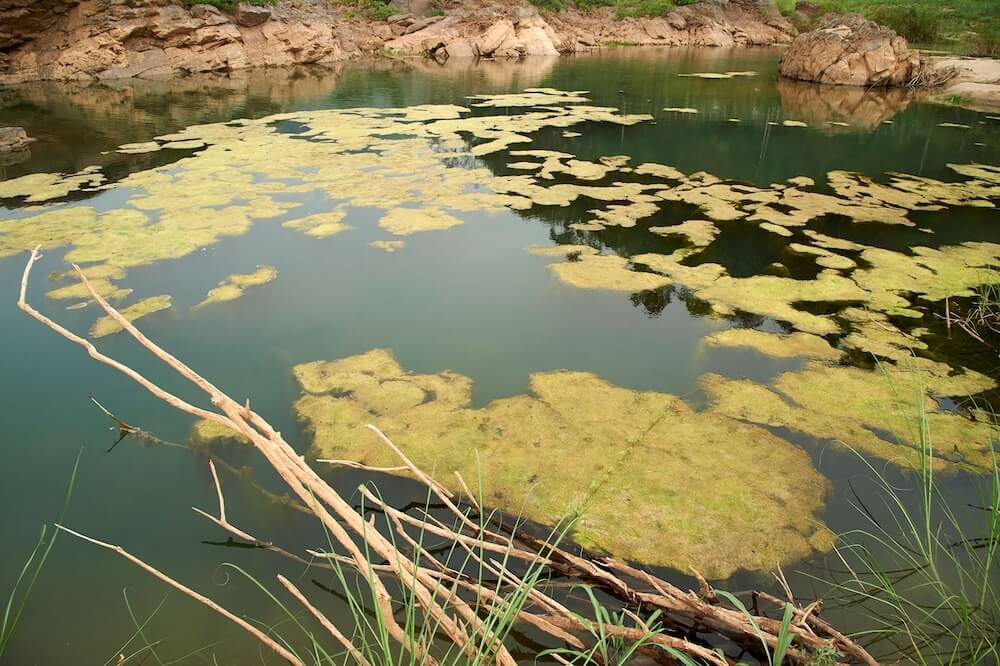
Key objectives
- Reduce the risk that water quality within the impoundment limits other uses — such as fisheries — or harms human health or damages hydropower structures such as turbines.
- Minimise downstream water-quality impacts on fisheries, aquatic ecosystems and human health.
- Ensure alignment with the Procedures for Water Quality under the Mekong Agreement.
What the guidance addresses
The guidance covers dissolved oxygen, thermal stratification, nutrient and contaminant release, greenhouse-gas considerations, and water-quality monitoring during impoundment and operation.
118. The objectives for water quality are:
- Reduce the risks that water quality within the impoundment will impact the use of the impoundment for other purposes, such as fisheries, or will impact human health, or will cause interference with, and damage to, hydropower infrastructure such as turbines.
- Minimize water quality impacts of the dam on downstream fisheries, aquatic ecosystems and human health.
- Ensure alignment with the Procedures on Water Quality (see MRC, 2011) under the Mekong Agreement, which seek to maintain the water quality of the Mekong River mainstream.
119. Technical Guidelines for the Implementation of the Procedures for Water Quality (MRC, 2016), referred to as the “Technical Guidelines”, have been agreed by the countries and encompass guidance for the protection of human health, the protection of aquatic life, a framework for implementation, and water quality emergency response and management.
120. Potential water quality risks should be comprehensively assessed. Dams are at risk from, and may constitute risks to, water quality in rivers. Risks to water quality in dams can arise from the quality of the water in the river being dammed, which in turn is influenced by human activities in the catchment upstream of the dam. Forestry, agriculture, urbanization, and industrialization are all activities that can lead to degradation of water quality in rivers. Water quality risks for mainstream dams are shown in Table 4.1. Mainstream dams may experience fewer of these risks because they operate in run-of-river mode with relatively short water residence times in the impoundment, or they may experience a number of these risks because of issues caused by surrounding land uses and tributary developments. All risks should be considered and assessed, including through consideration of atypical scenarios (e.g. floods, intense storm events, droughts) to see if any may emerge under particular circumstances.
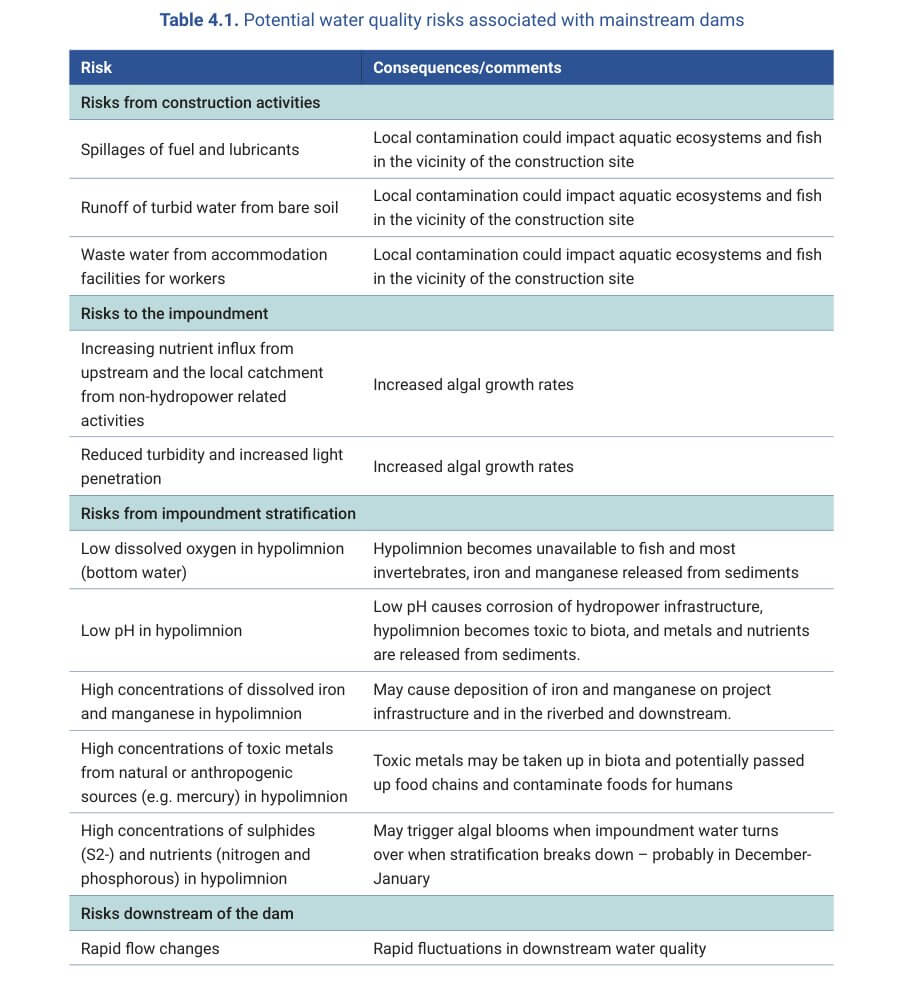
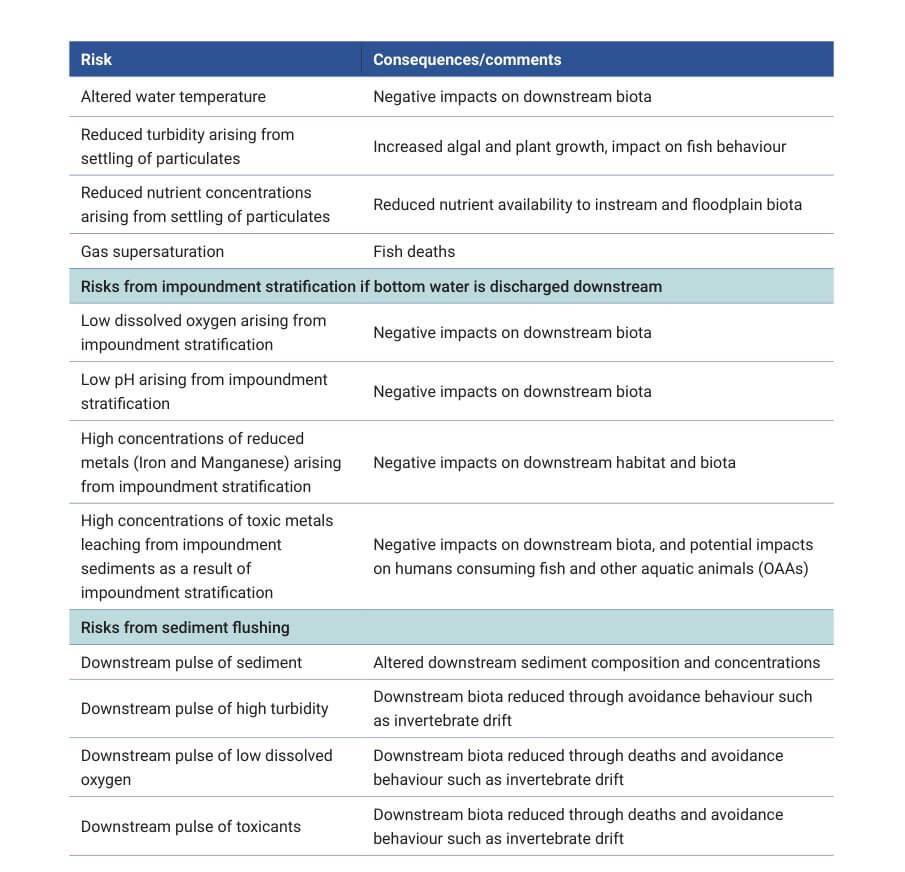
121. When water is held in a dam, its condition will change, with potential changes including a loss of suspended material, increased biological activity, and physico-chemical changes such as heating by the sun. Some of these changes pose risks to dam operators, as well as the river downstream.
122. Stratification risks are related to the transparency of the water, solar radiation, the morphology of the impoundment, the inflow-to-storage ratio, location of the intake, and nature of the catchment. Stratification occurs when cooler water sits below a thermocline and warmer water forms a layer above it. Oxygen does not diffuse readily across the thermocline, so the cooler bottom water, the hypolimnion, may become anaerobic, with a low pH, and high concentrations of dissolved metals, such as iron and manganese, and even toxic metals such as mercury, which dissolve out of the sediments. The following should be considered:
- Risks are lower in shallow impoundments with high inflow-to-storage volume ratios, however can increase in cascade settings where the progressive storage of water can alter temperature regimes.
- Risks are higher in deep, large volume dams, with low inflow to storage ratios.
- Risks are higher in tropical reservoirs where strong thermal gradients may establish rapidly.
123. Gas supersaturation is a condition that occurs when the partial pressures of atmospheric gases in solution exceed their respective partial pressures in the atmosphere. It can occur when water is exposed to air that is at higher than normal pressure in hydropower turbine systems or dam spillways. When the sum of the partial pressures of all dissolved gases exceeds atmospheric pressure, there is potential for gas bubbles to develop in water and in the aquatic organisms that inhabit the water. This causes a condition known as gas bubble disease, which can kill fish and invertebrates.
Guidance for monitoring
124. The monitoring approach for water quality should be shown in the PNPCA information to be sufficient to inform design, to support modelling for impact prediction, and to help with later impact evaluation. The guidance on monitoring locations and frequency, analytical methods, quality assurance and assessment and reporting contained within the Technical Guidelines should be referred to by developers. Clause 23 provides basic principles to guide design of the overall monitoring network. The following clauses can be used as a guide, and varied to suit project-specific conditions.
125. An overall design for data collection for evaluation of water quality risks and potential impacts should be established during the project design stage to match the project site and particular project data requirements. The following locations should be considered in order to inform the analyses that are presented with the PNPCA information:
- Water quality monitoring sites should be established upstream of the maximum extent of backwater of the impoundment, and at multiple sites downstream of the dam site in line with the hydrologic monitoring sites (Section 2.3).
- Additional monitoring locations should be established, as applicable, within tributaries entering the impoundment that provide more than 2% of the annual average Mekong flow as determined upstream of the confluence.
- Additional monitoring locations should be established, as applicable, upstream and downstream of the first tributary downstream of the dam that contributes more than 0.5% of the annual average Mekong flow at its confluence, to establish whether impacts extend as far as the tributary, and the extent to which the tributary flows ameliorate any impact.
- Additional monitoring locations should be considered upstream and downstream of any locations on the river in the zone affected by the project (see Clause 20) where known sub-standard water quality discharges exist, such as due to industrial activities, so that project-related impacts will be able to be distinguished from other causes of impact.
126. Project-specific water quality monitoring sites should be positioned so that the data sets can benefit from interpretation from existing and longer-term water quality monitoring sites. There is a substantial database on chemical water quality in the Mekong mainstream and some major tributaries, with information extending back to 1985. Local conditions should be able to be interpreted within the long-term larger-scale MRC data set.
127. The duration of water quality data collection should enable coverage of the full annual cycle with low and high flows, as well as provide insight into inter-annual variability, which is substantial in the Mekong and should be factored into project design. A common approach to setting targets for water quality parameters is to establish a threshold equivalent to the 80th percentile of the pre-project condition, which should be informed by two years of monthly water quality samples. A two-year water quality data set should be submitted with the PNPCA information so that targets could be set in this manner. This dataset may be collected through at least one year of monthly site-specific monitoring extended with data from other monitoring programmes; the MRC data are recommended due to its high quality. The field data collection should continue through the pre-project period to capture more of the inter-annual variability and be used to inform detailed design.
128. The parameters currently included in the MRC water quality monitoring programme should guide those to be monitored during the pre-project stage, and thereafter, as shown in Table 4.2. Additional parameters should be added, as required, during construction and operations, as outlined in Section 4.5.
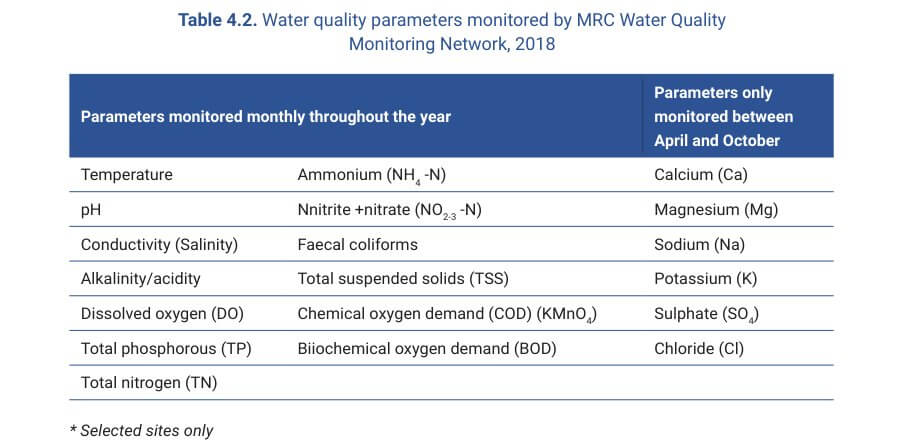
129. To set up the water quality monitoring in a manner that will enable statistically significant comparisons of changes during construction and operation with the pre-project conditions, at each sampling location, a minimum of five water quality samples would be collected across the surface of the river to capture variability during the first year. After one year of sampling. the number of samples should be reviewed and a power analysis conducted to determine the number of samples necessary to compare impacts post-project development.
Data analysis and impact prediction
130. The analysis of projected water quality impacts from mainstream hydropower projects should consider the potential direct impacts associated with the proposed hydropower project and take into account trends in water quality shown by the long-term MRC data. Forward projections of water quality should be made and should be used to guide mitigation strategies.
131. Analyses of the potential for stratification and for gas supersaturation should be undertaken, taking into account considerations identified in clauses 122 and 123. These analyses may benefit from the use of modelling at a degree of sophistication sufficient to establish if the risk is prevalent or not.
132. The analyses of changes, impacts, and mitigation options for water quality should clearly identify the residual impacts and document where these will occur in the river, in line with Clauses 7 and 25.
133. Mitigation options should be evaluated to determine which ones will best address identified risks. The monitoring and analytical results and project information should be used to evaluate the potential water quality risks associated with the project, and identify and optimize appropriate mitigation measures. Mitigation options to address potential water quality risks relating to mainstream dams are summarized in Table 4.3 , together with appropriate indicators to monitor and assess these risks. A number of these risks may not apply to the project, and there may be additional risks that require consideration. These mitigation measures are additional to those identified in the sections on hydrology and hydraulics (Section 2), and sediment transport and geomorphology (Section 3). Additional guidance on mitigation in the case that some of the key risks are prevalent is provided in the clauses following Table 4.3.
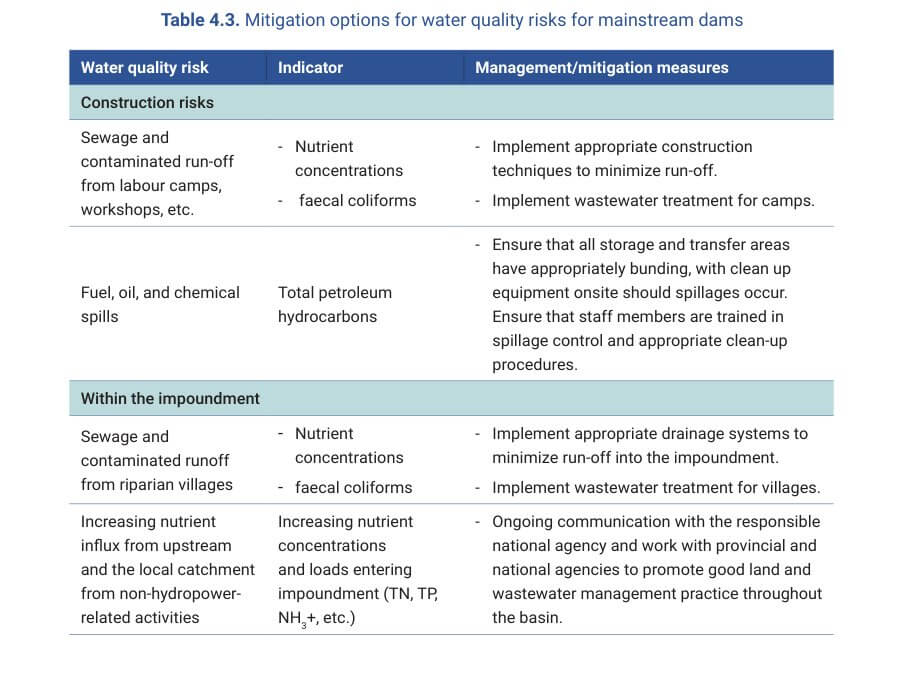
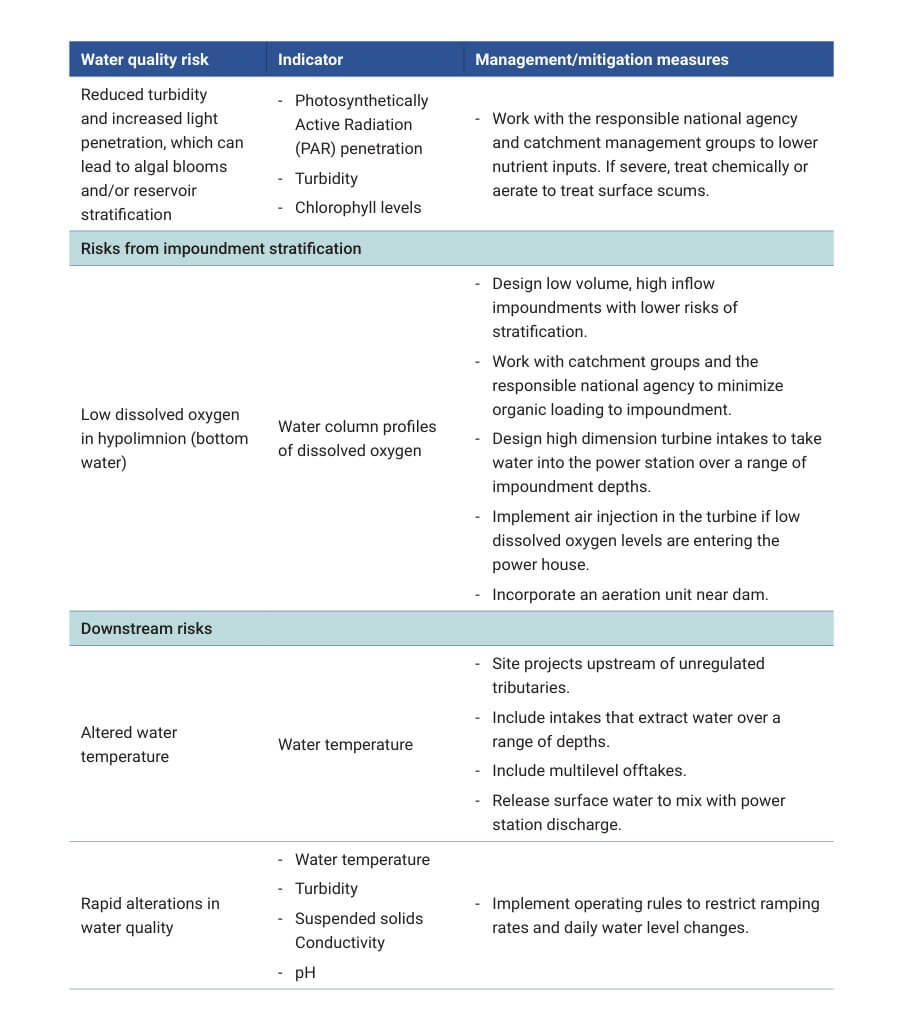
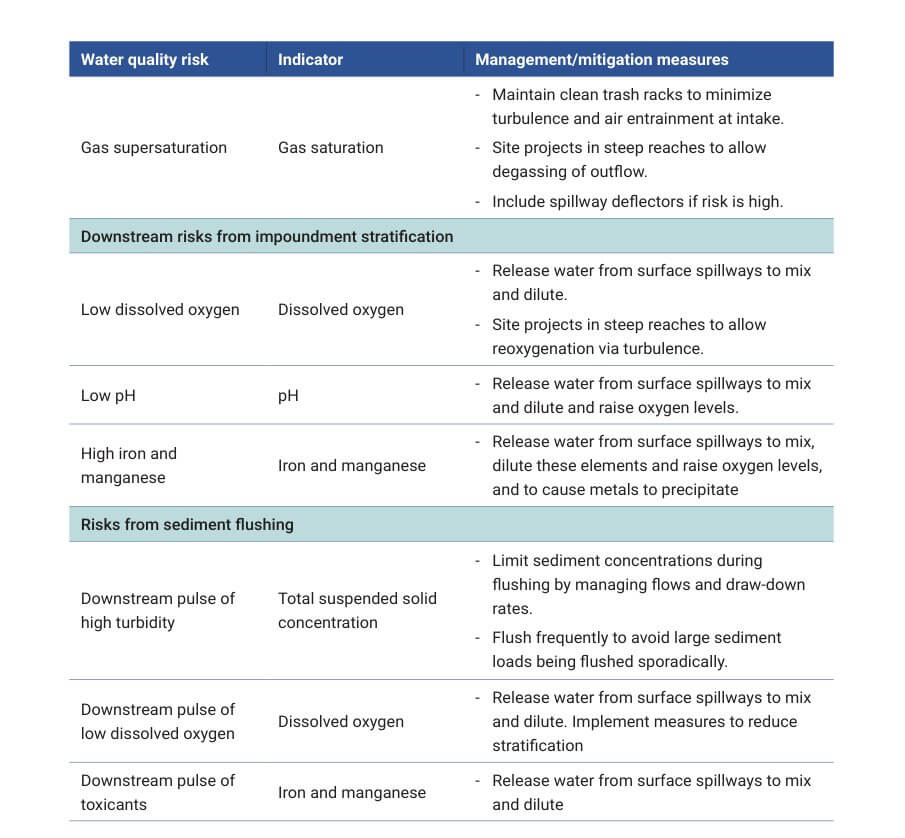
134. Environmental management plans for the construction period should be developed that identify the construction water quality control practices to be implemented to reduce sediment and contaminated water runoff, and the control practices for spillages of chemicals such as fuels, lubricants, and additives.
135. Management of water quality within the impoundment is important. Water in the impoundment will provide a potential resource for local people who may relocate to gain better access. People settling near the reservoir constitute a potential risk to the water quality and are also at risk if the water quality deteriorates. Particular risk factors are pathogens in the water and possible parasites arising because of below-standard sanitation in riparian communities and lack of alternative clean water sources. Below-standard water quality within the reservoir also constitutes a risk to the river downstream.
136. Identification and management of stratification should be a high priority. If recognized as a high risk, multi-level offtakes or other infrastructure should be considered, and appropriate operating rules applied, so that water released is at an appropriate temperature and chemical composition. If there are uncertainties about the formation of stratification and its consequent effects, then the design of the project should enable later retrofit of destratification mitigation approaches.
137. If stratification occurs and is a source of harm, and if multilevel offtakes are unavailable or cannot be deployed to address the issues, then destratification technologies should be considered to ensure suitable downstream water quality, as follows:
- It is not usually necessary to destratify the entire impoundment, only the water adjacent to the outflow sites to ensure that the outflowing water is oxygenated, has circumneutral pH, and is not enriched with reduced metals.
- There are a number of different destratification technologies that may be suitable, including pneumatic and hydraulic diffusers that can be installed on the bottom of the impoundment, propellers that can be installed within the water column, and impellers and hydraulic jets that may be installed on the impoundment surface.
- In the case of hydropower impoundments, pneumatic bubble plume systems are often favoured because the complex equipment, the air compressor, is operated from the surface and thus easy to service, the system is easily installed and relatively cheap, and power for operation is normally available onsite. The technique is only effective for dams where the water depth is greater than 5 m, and surface aeration techniques would be most suitable for shallower water bodies. There are a number of models that may be used in order to select the most appropriate destratification technique for any particular impoundment.
138. Rapid flow changes from the impoundment, either resulting from typical or atypical operations, can result in rapid changes in downstream water quality if the quality of the water being suddenly released differs from that usually released. This is especially applicable to water temperature. Rapid changes in water quality may result in deaths or emigration of aquatic biota from the area affected. In the case of the Mekong dams, virtually all the water downstream of the dam as far as the next substantial tributary will be water that has passed through the dam. Mitigation approaches include the following:
- Apply operating rules that limit up- and down-ramping rates as well as water level fluctuations.
- Site projects so that downstream turbulence will allow rapid equilibration of water temperature and dissolved oxygen to ambient conditions.
- Under some scenarios, the use of a downstream water retention pondage may be warranted to allow time for equilibration of the chemical change. Note that the furthest downstream impoundment in a cascade can be operated as a re-regulation pond if required.
139. If gas supersaturation is an identified risk for the project, the most practical and effective mitigation strategy is to design spillways and outflow channels with flow deflectors or “flip lips”, which divert the spilled water to the surface of the tail water rather than allowing it to plunge to the bottom of the stilling basin. Other measures applicable where a surface spillway is absent include:
- maintaining clean trash racks to minimize turbulence and air entrainment in the intake; and
- siting of projects such that the discharge is subjected to turbulence to allow de-gassing of the water.
140. Water quality risks associated with sediment flushing (Clause 107) include elevated concentrations of suspended solids, elevated nutrients, and potentially below-standard water quality if the impoundment is stratified, or if sediment pore water quality is of low standard. Water quality considerations and mitigation measures during flushing include:
- Avoid flushing during base flow periods when natural river suspended solids levels are low and stratification risks are high.
- Implement maximum sediment concentration limits during flushing and releasing large volumes of surface water during and following sediment flushing to dilute concentrations and transport material downstream.
- Implement sediment flushing early in the monsoon season so subsequent high flows continue to transport sediment downstream.
- Consider dredging and land-based disposal if downstream water quality risks outweigh the benefits of sediment release.
141. Plans for project monitoring of water quality presented in the PNPCA information should take into account the guidance in Clause 26. The PNPCA information should demonstrate that plans for water quality monitoring information to be collected during construction and operation will inform:
- developers’ needs regarding water quality management; and
- indicators that may signal a need for adaptive management responses to water qualityrelated mitigation measures.
142. The monitoring programme described in Section 4.3 should be conducted during the construction and operation stages, and adapted where needed to better inform construction and operation stage information requirements for management. Indicators shown in Table 4.3 should be included to assess the particular risks and mitigation options applicable from that table.
143. Construction stage water quality risks will be highly relevant to all projects, and the construction stage water quality monitoring should be closely focussed on those risks. Total petroleum hydrocarbons should be included in the parameter list in relation to fuel, oil or chemical spills, and nutrient concentrations and faecal coliforms should be used to indicate sewage or contaminated run-off from the construction site.
144. During the operation stage, water quality monitoring should continue at a monthly frequency at monitoring sites upstream and downstream of the impoundment, and within the impoundment. At sites located within the impoundment, water quality samples should be collected from multiple depths at each monitoring site to identify if stratification is occurring.
145. Water quality sampling programmes downstream to assess dam impact need to be adaptive, and an increase in sampling frequency may be warranted if water quality conditions pose a risk to the ecosystem or local or downstream users. The plans for project water quality monitoring included with the PNPCA information should consider events, thresholds, and potential management responses, so that any necessary design considerations can be incorporated into the project. The following are some examples of events that may warrant increasing monitoring include:
- stratification of the impoundment resulting in the release of de-oxygenated water to the downstream river;
- a water quality incident such as a fuel spill that can impact users; and
- the occurrence of a toxic algal bloom.
146. Results of water quality monitoring should be compared to national standards and also the water quality targets contained within the TGPWQ. Some specific thresholds that are recommended for the projects as indicators of the need for management responses are as follows:
- Temperature of the released water should be no more than 3°C warmer or colder than the river water upstream of the impoundment.
- The concentration of dissolved gasses, such as oxygen, in the tailrace should not exceed 110% of saturation at the appropriate temperature and salinity.
- Results exceed the national and/or TGPWQ in 20% or more of monthly samples collected over a period of two years.
147. Where thresholds are exceeded, plans should show that investigations on the cause of the issue and potential remedial action would be commenced, and identify the decision-making process and pathway for action commencement as per Clause 27. These investigations and actions may require the involvement or be the responsibility of the responsible national agency if the source of the water quality exceedance is not related to hydropower.
148. The following parameters and locations can be added to the monitoring programme if needed:
- iron and manganese monitored downstream in order to assess the risk of downstream release and deposition associated with sediment flushing, and in the case that the reservoir stratifies;
- chlorophyll monitored monthly to provide an indication of algal growth linked to excess nutrient inputs, which may be coming from the construction site or from surrounding land uses. Cyanobacteria (blue-green algae) should also be assessed if chlorophyll concentrations exceed 5 µg/L;
- faecal coliforms collected on a monthly basis, with more frequent monitoring if levels exceed World Health Organization (WHO, 2003) guideline values for recreational waters (95% of enteric bacterial counts < 40). Samples should be collected at the same sites in the impoundment as chlorophyll, with additional samples collected 3–5 m from the water’s edge in locations where there are human settlements within 1 km;
- vertical profiles of temperature, conductivity and dissolved oxygen in the impoundment at least monthly to detect any stratification trends. If stratification is a risk for the impoundment, profiles should be collected at approximately equidistant locations along the impoundment length, with one site located close to the dam wall to detect and document the temporal and spatial extent, and strength of, stratification; and
- A measure of light penetration or water transparency at the surface of each impoundment monitoring location, preferably using a Photosynthetically Active Radiation (PAR) meter or a turbidity meter. Turbidity should be determined on samples collected at depth.
149. If significant water quality concerns persist, consideration should be given to the installation of permanent continuous water quality probes at the inflow to the impoundment and downstream of the dam site. These could record temperature, conductivity, turbidity and dissolved oxygen and provide a continuous record of net water quality changes, whilst management measures could be tested for effectiveness.
Use the interactive database below to search, filter, and download formal guidance documents, technical papers, and checklists for this topic.
Use the interactive database below to search, filter, and download formal guidance documents, technical papers, and checklists for this topic.
| Title | Date | Type | Size | Link |
|---|