Riparian communities and River-Based Livelihoods
This topic addresses the people of the river — the communities whose lives, food and incomes depend on the mainstream and its resources.
Download this section (PDF)
Key objectives
- Avoid, minimise and mitigate impacts on riparian communities and their river-based livelihoods.
- Apply good practice to resettlement, livelihood restoration and benefit sharing.
- Give particular attention to food security, gender and vulnerable groups (GEDSI), with meaningful consultation.
What the guidance addresses
The guidance covers social impact assessment, resettlement and livelihood restoration, benefit sharing, and gender-responsive and inclusive engagement, consistent with the MRC's SIMVA and GEDSI work.
327. The objectives for riparian communities and river-based livelihoods are:
- Engage directly-affected riparian communities in all phases of the projects development and operation in a participatory manner.
- Ensure that directly affected riparian community livelihoods are better than, or at least restored to, pre-project levels.
- Implement these support measures, where feasible, within existing institutional frameworks (e.g. the MRC, the government at various levels, civil society organizations).
- Enhance existing, or create new, transboundary cooperative mechanisms as needed (e.g. to implement support mechanisms for transboundary riparian communities), such as through national, bilateral, regional and MRC-related frameworks.
328. The socio-economic dimensions of hydropower development on the Mekong River are recognized in the 1995 Mekong Agreement and the MRC vision. These general directives have not been translated into specific MRC policies, procedures or guidelines. Member Country governments maintain the primary responsibility for managing socio-economic impacts within their borders, and may enter into bilateral and/or regional agreements to resolve transboundary issues of mutual interest or concern.23
329. The MRC Indicator Framework includes strategic indicators related to social issues (living conditions and well-being) and economic issues (livelihoods and employment in MRC sectors). This section of the Guidance only addresses a subset of these indicators, namely impacts caused by hydropower-induced changes in the river system associated with riverbased livelihoods. River-related well-being is only addressed regarding community health and safety aspects, which are covered in Sections 4, 5, and 7. Other social and economic changes are not within the scope of this Guidance, such as disruption of social networks due to resettlement, impacts on cultural heritage, changes to livelihoods due to land acquisition, or impacts on the availability of electricity, whether at the local or national level.
330. Definitions relevant to this section are as follows.
- Residual impacts are impacts that remain after all viable avoidance, minimization, and mitigation measures have been applied. 23 Note that all developments must first and foremost comply with the laws, policies, and standards of the host country (see Clause 12).
- Livelihood is defined as the capabilities, assets (stores, resources, claims, and access) and activities required for a means of living.
- In the Mekong mainstream context, a river-based livelihood may include: harvesting of fish and OAAs, riverbank and floodplain agriculture, riverine transport, sand-mining, tourism; service provision in relation to these activities; and/or processing and trading activities in relation to these activities.
- In the context of Mekong mainstream dam development, a directly affected riparian community is defined as those communities residing alongside, upstream and downstream of a hydropower project who have river-based livelihoods that are directly affected by changes in the river system. For practical purposes, this is a subset24 of the population within a 15-km corridor on both sides of the river who are considered the riparian population, based on the precedent set by MRC socio-economic monitoring. Determination of the longitudinal extent of significant changes in the river system upstream and downstream is as described under Clause 25 and addressed in Sections 2 to 8.
- Directly affected in this context means that the residual impacts can be shown to directly impact on river-based livelihoods of the riparian communities. Indirect impacts (for example, impacts from induced population migration, or changes to prices for fish or construction materials in urban areas) are not within the scope of this guidance.
- Vulnerability (IHA, 2020) refers to the inability of people, organizations, and societies to withstand adverse impacts from multiple stressors to which they are exposed. Vulnerable groups are those people who by virtue of gender, ethnicity, age, physical or mental disability, economic disadvantage, or social status may be more adversely affected by project impacts than others and who may be limited in their ability to claim or take advantage of project assistance and related development benefits. A vulnerable individual is a person who, by virtue of gender, ethnicity, age, physical or mental ability, economic disadvantage, or social status, is experiencing hardship and would benefit from targeted support or assistance. Small adverse changes in their livelihoods can be enough to cause them to fall under the poverty line. They may be at risk of discrimination. They will often find it more difficult to adapt to rapid social change, which disrupts traditional norms and social safety nets. They can be less able to deal with monetary compensation, and more dependent on in-kind compensation. Vulnerable households and individuals can benefit from a case-by-case approach to management, which should involve good cooperation with relevant government agencies. Indigenous peoples may be among those who are highly vulnerable to project impacts. 24 This subset of population will have both river-based livelihoods [Cl 330 (iii)] and be part of the directly affected riparian community [Cl 330 (iv)].
331. Since riparian communities along the Mekong mainstream will experience cumulative impacts from a range of developments, the attribution of impact to a single mainstream dam development requires careful analysis. Any project developer is responsible for the additional impact to that already experienced by preceding or concurrent dam developments, as far as can be attributed to limitations in effectiveness of that project’s mitigation measures.
332. Attribution of physical and biological changes in the river system to a particular hydropower project is addressed in Sections 2 to 8. Each of these previous sections has guidance on clearly identifying the likely residual impacts after proposed mitigation measures have been implemented. This section addresses attribution of livelihood impacts from these changes in the river system. Attribution requires isolating and estimating the particular contribution of a change to a livelihoods outcome. This requires clarity about the causality, and awareness of the many other factors that may evolve alongside the physical change.25 For example, as the river changes course, farmers may lose income or food security because their riverbank fields are eroded. A developer should mitigate or compensate for the value of lost land and production if the river has shifted because of impacts downstream of the hydropower project (and not because of natural erosion, or changes related to other projects, gravel mining etc.).
333. The Mekong River plays an important role in the lives of riparian communities as a source of income, food, water, and materials (e.g. sand for construction purposes), a route for trade and travel, a cultural asset; however, occasionally, it is a threat in case of flooding.
334. Hydropower projects have multiple impacts, both positive and negative, on river-based livelihoods of riparian communities. These impacts are influenced by: the siting, design, construction and operation of the projects; measures to mitigate negative impacts or risks; and measures to enhance positive impacts or opportunities. This section focuses on the residual impacts of a dam development on directly affected river-based livelihoods of riparian communities arising from changes in the river, assuming that the guidance in Sections 2 to 8 has been followed.
335. Residual risks (and opportunities) for riparian communities are cumulative because changes in the river system are the result of multiple projects and other developments, with the strongest contribution often from the project directly upstream and/or downstream. There may be impacts on riparian communities in the country where the hydropower project is located, and in other countries along the river; some impacts may dissipate with distance 25 Guidance on attribution can be found, for example, in chapter 4 of Leeuw and Vaessen’s (2009) Impact Evaluations and Development. from the project (MRC, 2018a).
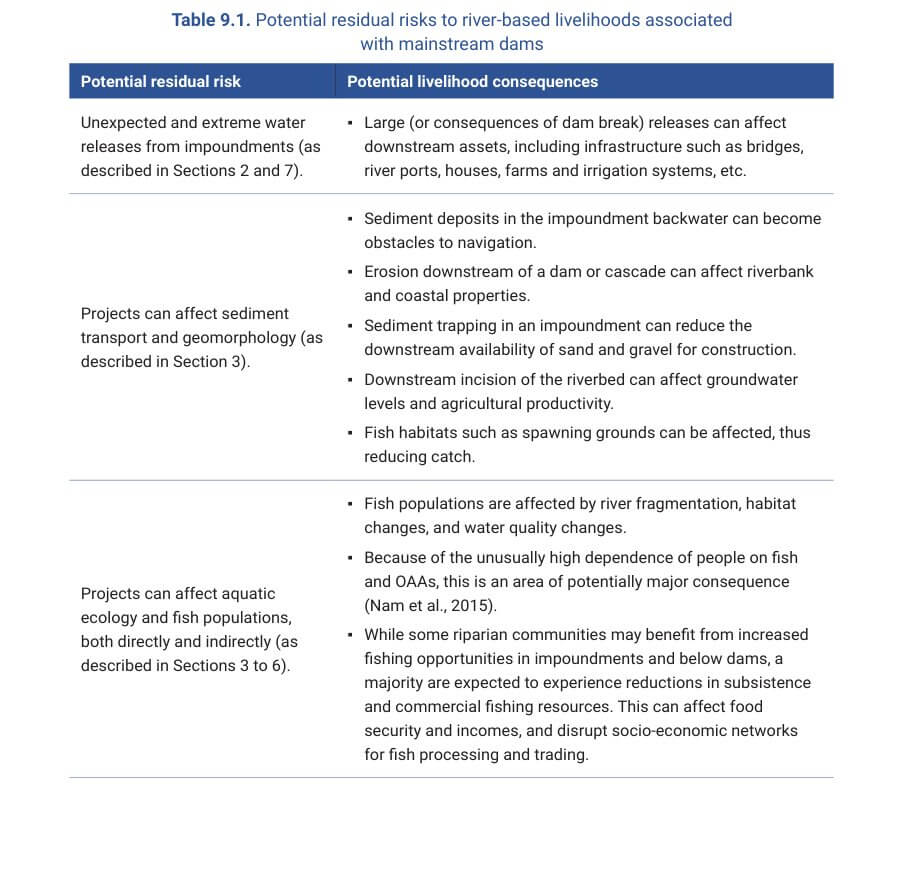
336. Residual risks to river-based livelihoods should be comprehensively assessed. Table 9.1 identifies potential residual risks to river-based livelihoods associated with mainstream dams.
337. The monitoring and analytical approach for riparian communities and river-based livelihoods should be described in the PNPCA to provide sufficient information to enable the understanding of residual risks, and should indicate the locations of directly affected riparian communities upstream and downstream of the project, and the extent of communities affected including gender-differentiated impacts. It should also include the identification and analysis of potential support measures, and should also support further analyses of the effectiveness of measures taken. Clauses 23 to 25 provide basic principles to guide design of the overall monitoring system and approach to impact analysis.
338. The pre-project analysis should identify and characterize the geographical extent of directly affected riparian communities, and their river-based livelihoods, and as per the definitions provided in Clause 330 and further guidance below. Information should be disaggregated by relevant characteristics including:
- ethnicity, because ethnic minorities frequently have distinct cultural traditions and livelihoods;
- gender, because of the different roles of women and men in household livelihood strategies; and
- vulnerability, because vulnerable individuals, households and communities can be more exposed to risks and less able to benefit from opportunities, when their environment changes.
339. Communities should be consulted in a respectful and inclusive manner, ensuring that: they have access to relevant information; consultations are held in a timely manner to ensure results can still influence decisions on the design of the project and its mitigation measures; and community leaders as well as representatives of all relevant sub-groups (especially vulnerable groups) are heard, where necessary separately. Representatives should be selected by function (e.g. formal leadership functions), on the basis of statistically valid representation of all identified sub-groups, and self-selected on the basis of interest in the project.
340. For directly affected riparian communities that live a short distance from the project (i.e. within the area directly required for the reservoir and other infrastructure, within a specified radius of any project infrastructure, and/or as defined by the relevant national agency), baseline information to inform assessment of project residual impacts may already be required under national EIA regulations, and should provide:
- information on the number and location of households in each community, broken down by relevant characteristics;
- statistics on livelihoods within each community, correlated with demographic information; Some data for this baseline information that are available from national statistical services, while other data must be specifically collected from village and household surveys and consultations during project preparation. Some Member Countries have issued specific guidance related to some socio-economic aspects (e.g. Lao PDR is requesting developers to submit health impact assessments) which may contribute to this baseline information. The developer should seek as far as practicable to match the detailed baseline information for these communities with the data that can be obtained from the MRC’s Social Impact Monitoring and Vulnerability Assessment (SIMVA) and other secondary sources (see below).
341. From directly affected riparian communities living at a longer distance, i.e. living further upstream and downstream from the area described above, baseline data can be extracted from existing sources; the SIMVA regular surveys of households in the 15-km Mekong corridor are the preferred source. The following are the attributes of the SIMVA information:
- SIMVA data are available from the MRC, which can also provide other socio-economic information or direct developers to other sources (e.g. national statistics, local government information, and dedicated studies).
- The SIMVA provides consistent data with a focus on socio-economic dependence on water resources and resilience to changes in these resources, differentiated by socioecological zones and sub-zones along the lower Mekong mainstream, Tonle Sap and delta.
- The SIMVA is also set up to identify and track trends over time, which is necessary to document impacts that result from gradual changes to the river (e.g. geomorphological changes) and to allow for adaptive management.
- SIMVA parameters are part of the emerging MRC Indicator Framework, which is expected to guide strategic planning, State of the Basin reporting, and coordinated national-level monitoring. The SIMVA methodology is updated with each survey, but may not cover some parameters or locations where impacts are expected.
- Where available data are insufficient for baseline documentation and impact assessment, the developer may have to commission additional studies.
- While it is not practical to engage all longer-distance communities in a participatory manner, representative samples of affected communities as well as relevant experts and authorities should be consulted. This may include, for example, non-governmental organisations working at the community level, local and provincial government agencies, and academic experts.
342. All socio-economic data gathered during project preparation should be analysed and the results presented in accordance with good practices on social impact assessment (e.g. Kyam, 2018; Vanclay et al., 2015). Because socio-economic conditions can change rapidly, data should represent the current status. Data sources, analysis methods, people consulted, and other relevant information should be provided.
343. The focus of the analysis should be on the identification and, as far as possible, quantitative prediction of residual impacts, to inform design, operations, mitigation, and compensation decisions. This requires application of the predictive models used for Sections 2 to 8 to indicate the likely effectiveness of mitigation measures and the remaining likely residual impacts. These predictions of residual impact should then be linked to the predicted consequences on the riparian communities, within the scope defined in Section 9.1.
344. Impact prediction should distinguish between project-specific and cumulative impacts, and attribute impacts to individual projects wherever possible. Impact prediction should also distinguish between shorter and longer distance, and local and transboundary impacts.
345. Guidance on impact avoidance, minimization, and mitigation measures is provided in Sections 2 to 8. Measures at the project site to address negative impacts on river hydrology and hydraulics, sediment transport, water quality, aquatic ecology, fish, dam safety, and navigation will also partially address the induced socio-economic impacts on riparian communities. This section provides guidance on addressing the residual impacts that cannot be mitigated.
346. Residual socio-economic impacts on riparian communities will remain, because mitigation is rarely designed to fully eliminate impacts and may not work as intended, and because impacts are cumulative, resulting from multiple projects that may or may not be using good practice mitigation approaches.
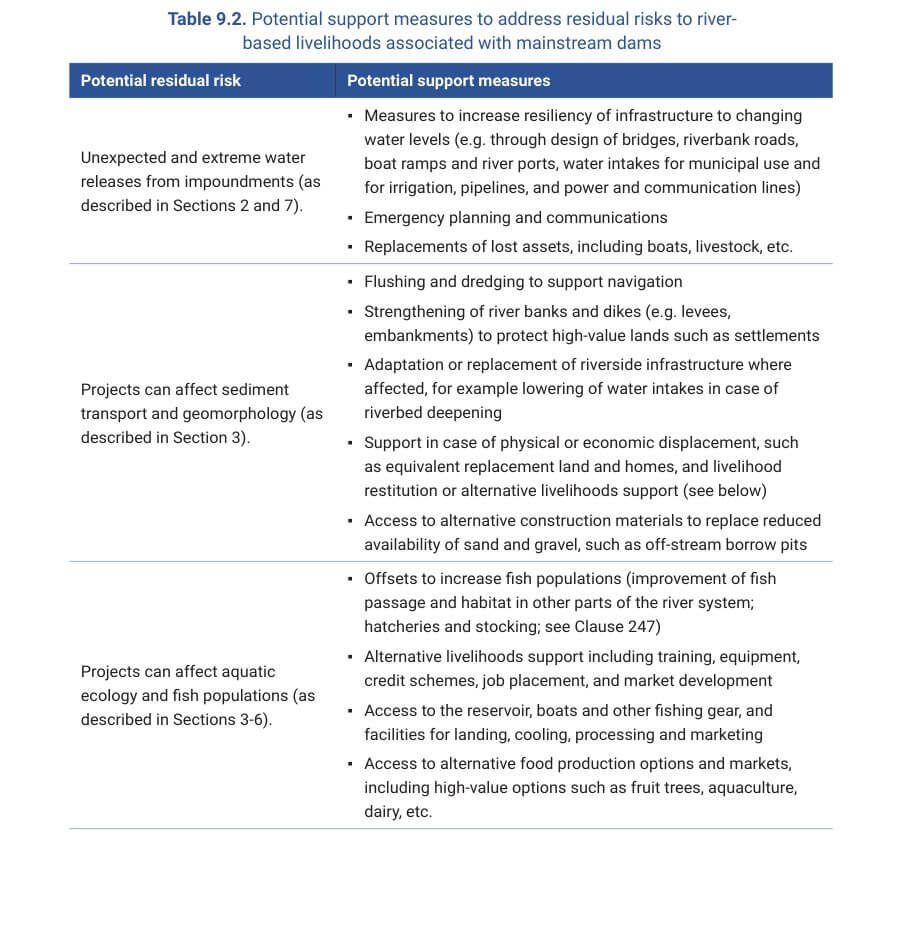
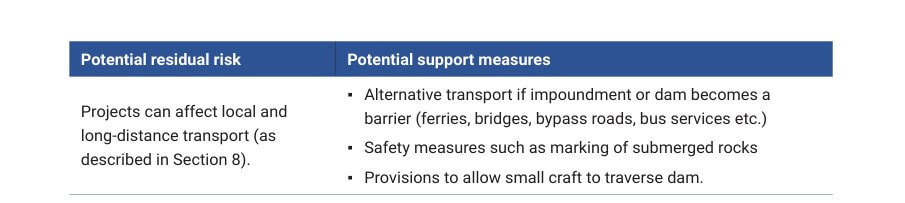
347. Options for support measures should be evaluated to determine which ones will best address residual impacts on riparian communities from the particular project under consideration. Table 9.2 outlines a number of support measures that may be considered to address the residual risks listed in Table 9.1. Proposed support measures should not be limited to those in Table 9.2 and may encompass others.
348. The developer should show that residual impacts have been identified, the consequences on riparian communities and river-based livelihoods have been described, and that various support measures have been analysed against the following criteria:
- Areas of impact should be prioritized in terms of impact magnitude, extent and consequence, and support measures proposed for priority impact areas.
- Support measures should directly relate to the area of residual impact (e.g. reduction in fish biomass), and ideally provide benefit for those riparian communities who are directly affected. It is recognized that timing of experience of impact and of benefit may be difficult to predict, but linkages between impact recipients and support beneficiaries should be made as far as practical.
- Support measures should be demonstrably practical and feasible, with an ability to easily clarify the contribution that should be made by the developer, as well as any other factors that may affect the success of the support. For this reason, one-time measures that can be implemented by the developer during project construction and then handed over to the relevant national agency are generally preferred over a measure that requires long-term commitment and management by the developer.
- Support measures should be cost-effective, with the proposals oriented towards those measures with the highest return for funding provided. Funding commitments should be adequate to fully cover all requirements for the support measures.
- Support measures should aim for sustainable outcomes in the long term. For example, one-off compensation payments are unlikely to address the core issue of river-based livelihood impact, whereas provision of a well-selected infrastructure contribution could provide a long-term benefit.
- Whether the directly affected communities are located at a shorter or longer distance from the project, and are local or transboundary may have implications for the proximity of monitoring, the ease of attribution, and the institutional arrangements required and practicality of different types of support measures. For example, measures that require continuous involvement by the developer over the lifetime of the project are more feasible for short-distance than for long-distance, transboundary impacts.
349. Depending on the results of the residual impact analysis, a number of support measures such as those listed in Table 9.2 may be warranted in order to adequately address the nature and degree of residual impact. As far as practical, every effort should be made to characterize the degree of residual impact and the appropriateness of the proposed support measure(s). For example, if a fish passage is designed for a certain percentage of effectiveness, the potential loss of catch can be calculated, and measures can be taken to compensate the residual impacts of this loss. Clause 247 provides a number of specific examples of potential offset measures that can be taken to address residual impacts to fisheries, and provides some technical guidance in relation to these measures.
350. Some support measures can be delivered in the form of river-related community benefits, for example from usage of the impoundment. These should be considered from an early stage and in dialogue with relevant national agencies to allow for setting appropriate rules and providing required facilities (e.g. boat ramps).
351. Developers are not necessarily best placed to practically implement longer-distance and transboundary measures directly. These measures may be best implemented through an appropriately funded National or Regional Agency or an alternative governance arrangement. It would be important for roles and responsibilities in any such arrangements to be tightly defined so that the funding support is directed in a timely manner to the intended focal area.
352. The most effective local arrangements for implementation and governance of any support measures should be identified in conjunction with national agencies, while those relating to cross-border arrangements may be identified in conjunction with the relevant Member Countries and/or regional agencies such as the MRC. These should be informed by MRC documents and frameworks such as the Basin Development Strategy. Cross-border support measures to address residual impacts may require new institutional approaches, including bilateral or multi-lateral agreements negotiated between Member Country governments that cover initial implementation and ongoing management responsibilities, such as the funding arrangements.
353. Additional information on aspects of good socio-economic practices related to hydropower not directly addressed in this Guidance is readily available (IFC, 2018a, 2018b; IHA, 2020; Wang, 2012).
354. Plans for project monitoring of riparian communities and river-based livelihoods should take into account the guidance in Clause 26. The PNPCA information should demonstrate that plans for livelihoods-related monitoring information to be collected during construction and operation will inform:
- whether avoidance, minimization and mitigation measures as described in Sections 2 to 8 are sufficient or if residual impacts are greater than anticipated;
- developers’ needs regarding management of any support measures; and
- indicators that may signal a need for adaptive management responses to livelihoodrelated support measures.
355. The developer is responsible for monitoring, either by gathering data directly, by using data from secondary sources, or by ensuring that data are gathered by a third party.
356. The effectiveness of any support measures should be regularly monitored. Depending on the nature of the measures, this may involve, for example, monitoring of the operation and maintenance of physical structures (such as fish passages) or of any activities that could reduce the success of such measures (such as fishing at a passage). If necessary, corrective action should be undertaken.
357. Additionally, specific socio-economic monitoring should be conducted to capture possible declines in river-based livelihoods. This should be differentiated by population groups, tracking key parameters initially identified for baseline studies (see Section 9.3 above).
358. In the shorter-distance riparian communities living alongside the project (see Clause 340), river-based livelihoods should be monitored under the direct responsibility of the developer. For the longer-distance riparian communities upstream and downstream (see Clause 341), monitoring should be conducted primarily through the MRC’s SIMVA surveys and other monitoring frameworks, as regularly reported under the MRC Indicator Framework and State of the Basin report, and data extracted and analysed to track project impacts. Updates to the monitoring frameworks that support improved understanding of impacts over time should be taken into account while ensuring consistency of data series.
359. Where analysis shows that publicly available socio-economic data are likely to be insufficient to capture impacts, both in scope (gaps in indicators and parameters) and in temporal and spatial resolution (surveys not frequent enough or not in the right locations), additional monitoring should be undertaken. Such additional monitoring may require clarification of responsibilities between developers and government agencies, and in the case of transboundary impacts, agreements between upstream or downstream Member Countries. These agreements may need to cover monitoring responsibilities and methods, as well as the regional and/or cross-border country for sharing data. To reduce the cost of monitoring and increase the compatibility of results, it may be undertaken in a cooperative manner with other developers, or with third parties.
360. If construction or operation stage monitoring detects significant declines of river-based livelihoods for directly affected riparian communities, which can be attributed to the project or to a group of projects (instead of to other changes in the river system), adaptive management options would include:
- revisions to project-level mitigation measures described in Sections 2 to 8, to remove the sources of residual impacts as far as possible; and/or
- additional support measures to address the consequences of residual impacts, such as listed in Table 9.2.
Use the interactive database below to search, filter, and download formal guidance documents, technical papers, and checklists for this topic.
Use the interactive database below to search, filter, and download formal guidance documents, technical papers, and checklists for this topic.
| Title | Date | Type | Size | Link |
|---|