
Dam Safety
This topic addresses the structural and operational safety of the dam across its whole life — design, construction, operation and emergency preparedness.
Download this section (PDF)
Key objectives
- Ensure the dam is designed, built and operated to recognised safety standards.
- Provide adequate spillway capacity for extreme floods and appropriate seismic design.
- Maintain instrumentation, surveillance, emergency preparedness plans and dam-break analysis.
What the guidance addresses
The guidance covers spillway and flood design, seismic considerations, instrumentation and surveillance, emergency preparedness, and the institutional framework for dam safety, complementing MRC dam-safety guidance.
256. The objectives for dam safety are:
- Ensure that a dam does not violate Article 7 of the Mekong Agreement by causing harmful damage to the environment (upstream or downstream) through its operation or in the event of any failure.
- Protect life, property and the environment from the consequences of dam operation or failure, based on an understanding of the risk imposed by the dam and the consequence of failure.
- Ensure that current national and international standards are used in design with preferably a consistent approach to design criteria for cascades of mainstream dams, specifically for the safe passage of extreme floods and seismic stability.
- Ensure that the design, construction, and operation and maintenance regimes, as well as institutional arrangements are consistent with national requirements and international good practice for the safety of dams and related emergency response planning.
257. Dam safety is of paramount importance for the individual dams on the mainstream of the LMB, as well as the safety of any cascade. The safe design, construction, and operation of dams depend on more than engineering factors. The approach to dam safety should recognize that failure of a dam is a complex process that can include human error at the design, construction, operation and maintenance and monitoring stages (ICOLD, 2005).
258. Risk-based design has become standard procedure in many countries worldwide. To fully understand dam safety, the risks imposed by the dam on the downstream environments should be fully understood. Risk assessments and failure mode assessments are important tools in contemporary dam design. Risk assessment processes at various stages throughout the design are encouraged to ensure that risks and uncertainties are understood by all key stakeholders and mitigated where possible.
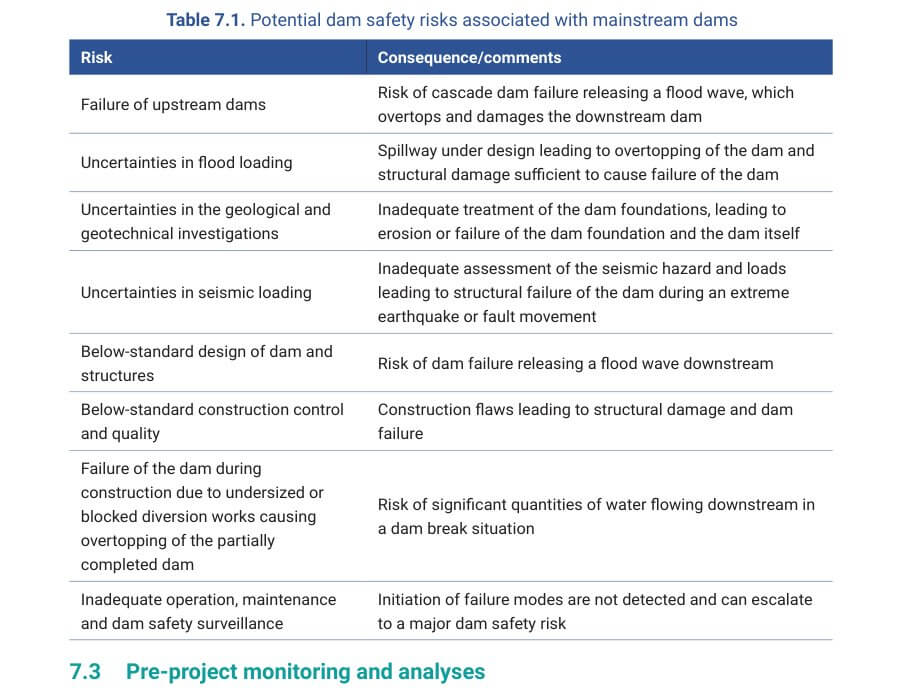
259. Potential dam safety risks should be comprehensively assessed. The key risks associated with dam safety are summarized in Table 7.1.
260. The developer should provide information in sufficient detail at the PNPCA process to demonstrate that this Guidance on dam safety will be fully implemented.
261. The most important baseline data related to dam safety are primarily those required for the hydrological studies to develop the design floods, and the geological information required for foundation and seismic hazard assessments at the regional and site-specific level.
Seismic
262. The developer should understand the regional seismic geological conditions as well as the site-specific situation.
263. The following should be considered in developing the seismic design criteria for the proposed site:
- International Commission on Large Dams (ICOLD) Bulletin 148 and other relevant ICOLD Bulletins (e.g. ICOLD, 2001) should be used to determine seismic design criteria.
- A detailed investigation should be undertaken of nearby significant faults, and evidence provided to show assumptions on activity of the closest faults.
- If there are no nearby active faults, then there should be a review of the regional seismicity parameters and their uncertainties for inputs to deterministic or probabilistic approaches.
- Aftershock impacts on the dam should be assessed.
- If investigations indicate the possibility of faults through the dam foundations, then the risk of fault displacement should be considered and mitigation measures included in the design.
- Kinematic models of potential tectonic displacement in the dam site should be completed. These should be updated as the project proceeds to take into account structural geological features found in the dam foundation during construction.
Floods
264. Section 2 (Hydrology and Hydraulics) of this Guidance should be referenced in relation to derivation of design floods and determination of both Cascade Joint Operating Rules and Project-Specific Operating Rules.
265. The check flood should be the probable maximum flood (PMF). Significant damage may be accepted to the structure and operation of the power station and the flood gates; however, there should be no catastrophic failure of the dam structure resulting in the release of an uncontrolled flood. The design flood should result in no structural or operational damage to the dam or spillway based on the worst-case scenario.
Impact identification
266. The developer should carry out a detailed Potential Failure Modes Assessment (PFMA) to identify the credible failure modes for the dam and appurtenant structures. The PFMA should be used to reduce the risk of failure of the dam, and to inform the development of the Dam Safety Management System (Clause 283) and Emergency Preparedness Plans (Clauses 286 and 290).
267. The developer should demonstrate the extent of the following key risks posed by the dam on the upstream and downstream communities and environment.
- Natural floods: These should consider a range of annual exceedance probabilities (AEP) from the annual flood up to the PMF. These assessments should be carried out both with and without the dam, and demonstrate the impact of the proposed operational rules required to pass these major floods on both the upstream and downstream areas of the dam.
- Faulty or accidental operation of the dam. These assessments should demonstrate the impacts of faulty operation of the scheme, in particular, the faulty operation of flood gates. Faulty operation includes the failure of flood gates to open and the accidental operation of the flood gates.
- Dam break flood assessments. The dam break flood assessments should demonstrate the impact of failure of the dam during flood situations, periods of low flow, and construction. Modes of failure should be investigated (Clause 266), and credible failure scenarios should be used to derive the dam failure flood hydrographs.
268. The potential impacts listed in Clause 259 should be assessed using detailed hydrodynamic modelling. Modelled flood extents, with and without the dam, should be superimposed on maps of the area to identify the people, property, and structures at risk from the project. Modelling should extend upstream and downstream of the dam to the point at which the difference between the pre- and post-dam flood depth is less than 10 cm, or to the point at which it is clear that the additional dam break flood depth no longer poses a risk to people and property.
269. Where the impacts of the dam affect the operation of other infrastructure upstream or downstream, the developer should provide mitigation measures to eliminate or minimize these issues in consultation with the owner of the affected infrastructure and the responsible national agencies.
270. Details of the impacts, including numbers of people at risk and vulnerable structures or environmentally sensitive areas, should be identified by the developer. In assessing the impact of the dam to the upstream and downstream communities, the developer should take into account itinerant users of the river as well as the fixed communities. These itinerant users may include boat traffic (tourist, fishing, cargo and others), fishers (in boats and on the riverbanks), and other riverbank users. This aspect of the assessment will be important information for the assessment of Riparian Communities and River-Based Livelihoods (Section 9).
271. Modelling described in Section 2.3 and Clause 268 should be used to develop dam break and natural flood maps for emergency planning, showing at a minimum: areas at risk; flood depths; velocity; and flood wave travel times for the inundation areas. These maps should be developed in cooperation with the local emergency management teams to provide them with the information they require for emergency planning. These may include hazard maps (velocity times depth) in addition to the flood depth, velocity, and travel time maps.
272. The dam safety risk management analyses should clearly identify any residual risks and document where these will occur in the river, in line with Clauses 7 and 25.
273. This sub-section defines specific requirements that should be demonstrated during the development of the concept/feasibility design to be submitted for the PNPCA process. While full details will be finalized during the detailed design and construction stages, sufficient details should be submitted for the PNPCA process to provide confidence to the MRC Joint Committee that the development will be designed, constructed, and operated safely.
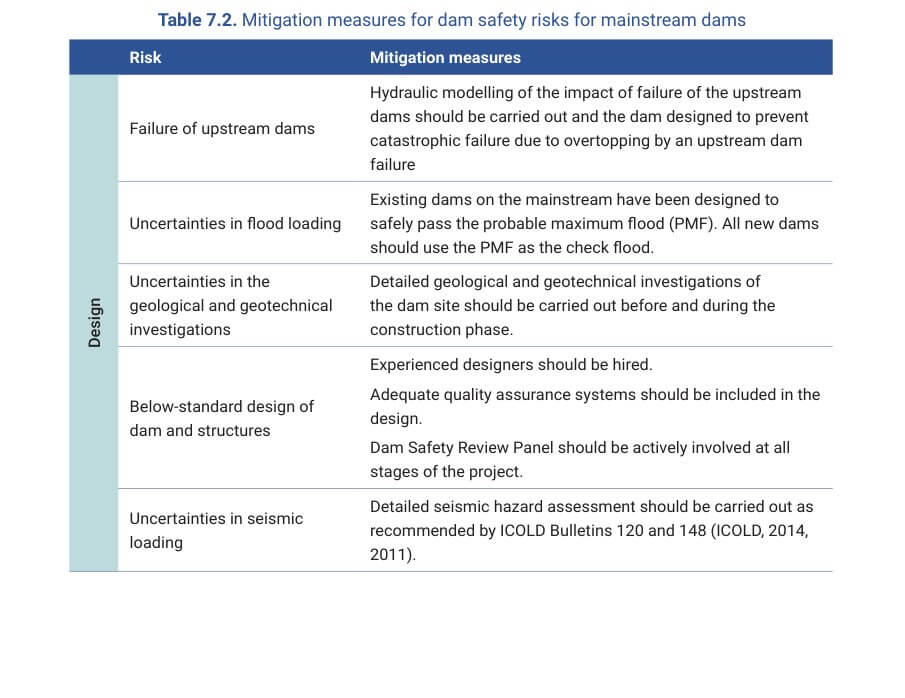
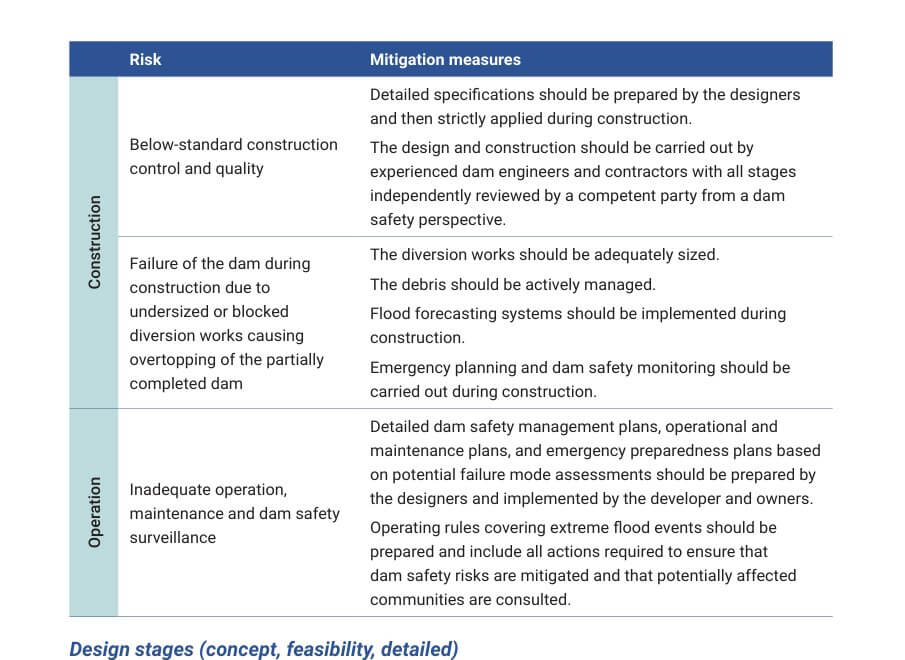
274. Table 7.2 identifies mitigation measures for the risks identified in Table 7.1. The developer should demonstrate, at the PNPCA process stage, how they intend to mitigate these risks.
275. National standards relevant to dam safety of the responsible Member Country should be met unless this Guidance specifies more stringent criteria in the interest of transboundary safety, as per Clause 12. Where specific guidance is not provided in this document, international dam safety good practice should be used, such as documented in the World Bank Operational Manual and ICOLD Bulletins (ICOLD, 2005, 1987).
276. During the design stage, the structures and systems that are critical to the safety of the dam should be identified. In particular. where systems such as spillway flood gates rely on mechanical and electrical control equipment, the system should be designed with back-up systems to ensure reliability in emergencies. The developer should identify which systems are critical to dam safety and demonstrate that there is complete redundancy in the system.
277. A Dam Safety Review Panel (similar to those panels required under the World Bank Operational Policy OP4/37) should be appointed by the developer or the government of the host nation, and should meet the following criteria:
- The panel should consist of recognized independent experts in different aspects of dam safety.
- The experts involved in the review must have no role in the design or operation of the dam, nor financial nor other interests in the project, and it is accepted that they are providing an objective view, i.e. they are “independent”.
- The individuals involved in the review must have a high degree of knowledge of dam and infrastructure safety as a result of a significant experience and training in the relevant component of the dam that they are reviewing; i.e. they are “experts”.
- The panel should be appointed prior to the PNPCA process and make regular reviews throughout the investigation, design, construction and operational stages of the dam, including the first commissioning of the dam and operations.
- The panel members may be appointed under relevant national laws of the notifying country.15
278. The developer should include an independent review by the review panel (Clause 277) with the PNPCA information submission. This review should have been undertaken after the feasibility study has been completed. The information submitted should also identify the proposed inputs from the review panel during design and construction, the first commissioning of the dam, and at the start of operations.
279. The developer should include mitigation methods to control floating debris in the impoundment which could cause damage to flood gates or other plant and systems critical to dam safety.
280. If the navigational structure is to be used as part of the flood control measures, then this should be clearly identified in the dam safety documentation.
281. Flood flows through the dam structure should be safely discharged. The developer should demonstrate that adequate energy dissipation and scour protection is provided to prevent failure of the dam. This is particularly critical to the design of the spillway, low level outlets, and the turbine outlets.
282. If overshot flood gates are proposed, then detailed consideration should be given to the long-term maintenance and reliability of the gates to ensure that they can always satisfy dam safety requirements.
283. A dam safety management system (DSMS) should be prepared for implementation starting from design and continuing through the full construction and operation stages, and the plans for this should be described with the PNPCA information. This system should become 15 For example, Lao Electrical Power Technical Standards 2018 requires the appointment by Ministry of Energy and Mines of a “chief engineer” to review design and construction. progressively more sophisticated as the project moves through the development stages. To be consistent with international good practice, the DSMS would include the following:
- comprehensive dam safety reviews, involving independent inspections, scheduled at least once every five years. Dam safety reports should be copied to government, and follow-up inspections undertaken to confirm that the recommended work was undertaken. These reviews should be carried out by experienced engineers independent from the dam owner;
- annual dam safety reviews, including inspections, in order to check for damage and ensure functionality of critical structures, and to ensure completion of tasks identified for follow-up from previous reviews;
- details of how to identify and report dam safety issues;
- a surveillance system to identify the initiation of the failure modes, following on from the assessment described in Clause 266; and
- all dam safety relevant design criteria, monitoring and assessments, management plans, and review and inspections addressed in this Guidance.
284. The DSMS should include an instrument plan for dam safety monitoring to be incorporated into the project design. This plan should outline the location and type of instruments to be installed for monitoring and recording dam behaviour, and for obtaining related hydrometeorological, structural, and seismic information over the life of the project. The plan should include consideration of how the instrumentation will be used to provide early warning of initiation of any the potential credible dam failure modes.
Construction stage
285. The DSMS should include plans for construction supervision and quality assurance, to demonstrate how the developer will ensure quality in areas important for dam safety during the construction period. This should include the organization, staffing qualifications, procedures, and equipment for the supervision of the construction of a new dam. Experienced and competent professionals are required to design and supervise construction.
286. A Construction Stage Emergency Preparedness Plan should be provided that demonstrates the identification of and mitigation measures for risks to the project, project-affected area, and local communities during the construction period. The plan should include for failure of the partially completed dam or cofferdams during construction if the diversion works are overwhelmed.
287. Plans regarding temporary works construction and removal should be included in the DSMS as they relate to dam safety. Failure to remove all of the temporary works can have implications on the operation of the permanent works. The developer should demonstrate the full methodology for temporary works, which should include the removal of the works.
288. Plans relating to first filling of the impoundment should be included in the DSMS as they relate to dam safety. These should:
- identify the potential risks to dam safety during first filling and accompanying mitigation measures;
- include the monitoring and surveillance that will take place during this period in order to detect initiation of any of the potential failure modes;
- be linked to the Emergency Preparedness Plan; and
- be refined and completed during project implementation, and the final plan should be completed and accepted by the responsible national agency not less than six months prior to initial filling of the impoundment.
Operation stage
289. The following operating rules and actions are required to ensure that dam safety risks are mitigated:
- rules for draw-down of the impoundment ahead of floods, and for the operation of turbines and flood gates during floods;
- rules for flood gate operation while any gates are out of operation due to maintenance or upgrade; and
- any controls on impoundment water level or downstream flow ramping rates for public safety.
290. An Operation Stage Emergency Preparedness Plan (EPP) should be provided that includes:
- the specification of roles and responsibilities of all parties when dam failure is considered imminent, or when expected operational flow releases threaten downstream life, property, or economic activities dependent on river flow levels;
- specific reference made to the Cascade Operating Rules as they pertain to extreme flood management and the consultation with upstream and downstream projects;
- transboundary considerations and consultation and agreed protocols with relevant agencies in upstream and downstream Member Countries;
- a communication strategy to engage with stakeholders on dam safety issues and emergency preparedness activities that directly involve or affect them. This should provide for full and effective consultation with local communities and local government authorities as well as all concerned organizations and agencies.
- All concerned and affected people, including those in upstream and downstream countries who may be affected by dam operations, should be involved in the EPP preparation, in training and capacity-building for its implementation, and in response to any issues concerning annual Dam Safety reports;
- inundation maps based on dam break and natural flood scenario modelling (Clause 267) that indicate households and structures at risk that should be on warning or evacuation contact lists;
- details of the flood warning system;
- communication flow charts and contact lists, including households at risk; and
- Identification of emergency resources.
291. The project Operation and Maintenance (O&M) Plan should include aspects relating to dam safety, which should be incorporated into the DSMS. These aspects should address:
- the organizational structure, staffing, technical expertise, training, equipment, and facilities needed to ensure it; and
- O&M procedures, funding and other arrangements for long-term dam maintenance and safety inspections.
292. Plans for project monitoring, inspections and review relating to dam safety should take into account the Guidance in Clause 26. The PNPCA information should demonstrate that plans for dam safety related monitoring information to be collected during construction and operation will inform:
- developers’ needs regarding emerging issues; and
- indicators that may signal a need for adaptive management responses to dam safety related risk management measures or management plans.
293. For the life of any dam, the owner is responsible for ensuring that all appropriate measures are taken and sufficient resources provided for the safety of the dam. All management plans and systems identified in the clauses in Section 7.4 should be reviewed and updated annually, and training sessions should be implemented to ensure that all stakeholders are familiar with the plans relevant to them. The DSMS should ensure that all actions and findings are recorded in a manner that is easily retrievable over time, and provide for followup and continuous improvement.
294. Plans should indicate how and when the DSMS described in Clause 283 will be finalised and updated to suit the “as constructed” dam within six months of commissioning of the dam.
295. Plans submitted at the PNPCA stage should describe the Flood Forecasting and Warning System that will be developed to providing warning for all people within the inundation areas identified by the flood modelling and mapping (Clause 267). This should include plans for updates and periodic tests of the operation stage EPP (Clause 289). These plans should include flood forecasting and warning that may be required for upstream and downstream Member Countries.
Use the interactive database below to search, filter, and download formal guidance documents, technical papers, and checklists for this topic.
Use the interactive database below to search, filter, and download formal guidance documents, technical papers, and checklists for this topic.
| Title | Date | Type | Size | Link |
|---|
Use the interactive database below to search, filter, and download formal guidance documents, technical papers, and checklists for this topic.