About this Guidance
Preliminary Design Guidance for Proposed Mainstream Dams in the Lower Mekong River Basin (PDG 2022), Chapter 1.
Download this section (PDF)
10. According to the Mekong Agreement, before Member Countries may initiate any large-scale infrastructure development constituting an intra-basin use on the Mekong mainstream in the dry season, they should notify and consult with other riparian states in the basin. Under Article 5.2.1 of the Procedures for Notification, Prior Consultation and Agreement (PNPCA) (see MRC 2003a), the notifying Country should provide available and additional technical data. In this regard:
- This Guidance supports a consistent approach to information submitted by the notifying country, and to any technical review of this information undertaken during the PNPCA process.
- In order to demonstrate best efforts to avoid, minimize, and mitigate harm, the notifying country can show that it has made all reasonable efforts to recommend developers of proposed mainstream dams to consider this Guidance.
- A project that does not adhere to this Guidance can reduce or even negate the effectiveness of the mitigation measures applied by all other projects. Consistent application of this Guidance will give all Member Countries and each developer the confidence that all mainstream developments will be held to the same set of performance standards.
- Member Countries may draw on this Guidance to inform improvements to existing mainstream dams, which should enable and demonstrate consistency throughout all mainstream dam developments.
- The application of this Guidance does not limit the Notified Countries’ rights under the Mekong Agreement Articles 7 and 8. However, consistent application of this Guidance may limit the responsibility for damage under these Articles.1
- Under the Mekong Agreement Article 7, the Member Countries have accepted a Duty of Conduct to avoid, minimize, and mitigate harmful effects wherever they occur. This Guidance aims to reduce the likelihood of these damages through the application of the mitigation hierarchy. Adequate monitoring of dam safety and other risks, as set out in this guidance, should be conducted to accurately measure the changes resulting from hydropower operations. Cause and effect of these changes, including those resulting from more catastrophic events (e.g. dam break), may therefore also be better understood. In the case where damages are deemed to have occurred, state responsibilities for assessment and resolution of issues arising are dealt with under Mekong Agreement, Article 8.
- Under PNPCA, Article 5.4.2, other Member Countries may request additional information on a use notified for prior consultation, and this Guidance may be used to frame this request. The Joint Committee may also wish to refer to this Guidance when arriving at an agreement under PNPCA, Article 5.4.3 relating to the proposed use and agreed upon conditions.
1 Under Article 7, the notified country(ies) should prove with “proper and valid evidence” that they have suffered substantial damage, and should attribute that damage to a particular source or sources in notifying countries. Under Article 8, the affected parties should together identify the cause of, responsibility for, and should quantify, the damage. Thereafter, the affected parties should agree on mitigation measures in an amicable and timely manner.
11. Users of this Guidance will include Member Countries, developers, and interested stakeholders, as described below:
- This Guidance should inform the expectations of the notified Member Countries with respect to a development. This Guidance should also inform measures that can be taken by the notifying country in support of the development where this Guidance extends beyond what can be reasonably expected by the developer, or where a collaborative approach with other Member Countries may be warranted.
- This Guidance provides a framework for dialogue on the development risks and mitigation measures between participants in the PNPCA process.
- Member Countries may use this Guidance to form a basis for the Cascade Joint Operating Rules, so that all projects within a cascade would apply common design objectives and coordinated operations.
- Developers should use this Guidance to inform all stages of project planning, development and operations. Developers should enter into dialogue with the relevant national agencies regarding shared or divided responsibilities where needed to meet this Guidance. Developers can reference this Guidance in developing Project-Specific Operating Rules within the framework of the Cascade Joint Operating Rules.
- Interested stakeholders may not have direct uses for this Guidance, but can reference it when considering project information and in any dialogue relating to the project.
12. Developers should follow national standards in the development of mainstream dam projects, where they are equal to or more stringent than those in this Guidance.
- For impacts that are of basin-wide concern, because they are transboundary, cumulative, or affect basin-wide ecological processes, and where the national standard does not give adequate protection for these areas of impact, the more stringent standard between this Guidance and the national standard should guide the project design.
- Member Countries may wish to embed aspects of good practice outlined in this Guidance into their national standards for dam developments.
13. This Guidance does not replace national guidelines or regulations for the project Environmental and Social Impact Assessment (ESIA). ESIA guidelines are issued by the Member Country for developments within that country, for review by the relevant national agency as part of the statutory approvals process for a dam development. ESIA guidelines cover a broader scope than this Guidance. This Guidance is limited to information requirements for impacts of basin-wide concern relating to the potential harmful effects of mainstream dams.
14. Developers, Member Countries and the Mekong River Commission Secretariat (MRCS) may use this Guidance to create checklists against which information submitted for the PNPCA can be cross-checked. Incorporation of this Guidance into checklists may facilitate the prior consultation process. Completion of a checklist against this Guidance can provide substance to the “make every effort” commitment in Mekong Agreement Article 7.
15. Avoidance and minimization decisions are often taken during the pre-feasibility studies when considering the project location. Further avoidance and minimization decisions are taken during the feasibility studies when optimizing the siting and design, informed by the ESIA. Implementation plans for mitigation measures to address areas of impact are typically described in an Environmental and Social Management Plan (ESMP) for construction and operation stages, closely linked to the ESIA and submitted before project approval, and embedded within tender documents and major contracts. For optimal timing, feasibility studies should be done in parallel with the ESIA, and they should iteratively inform each other.
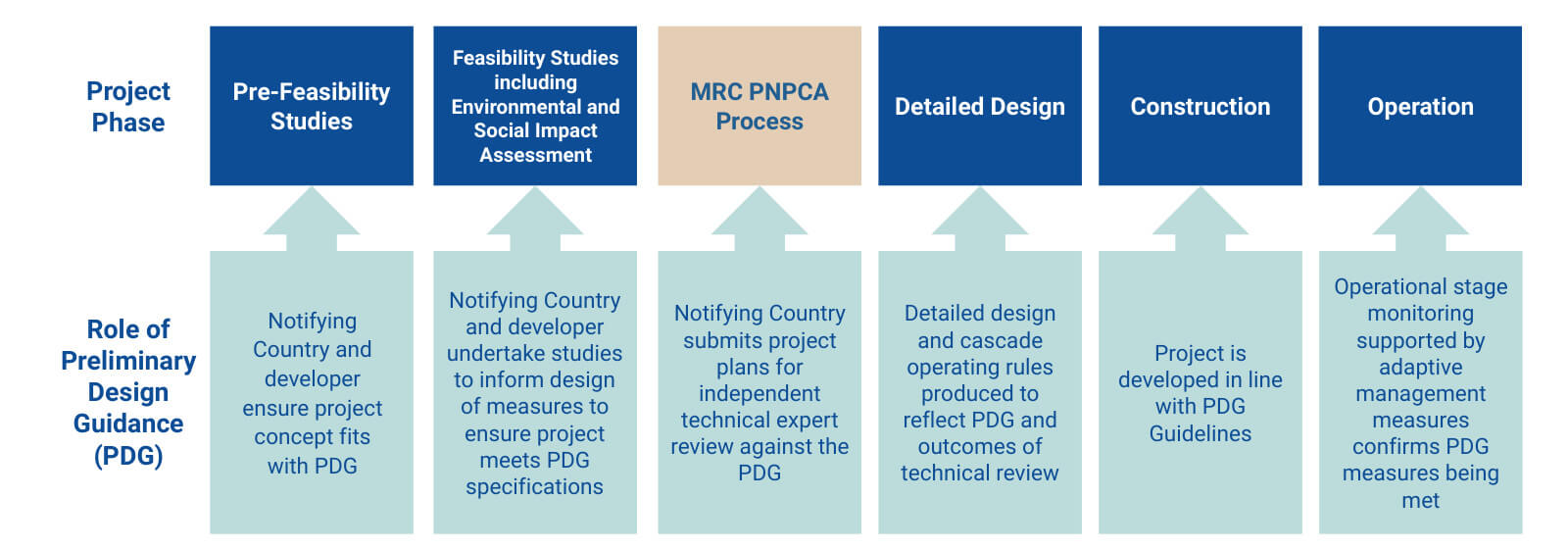
16. This Guidance should be referred to throughout the project development cycle. Reference to this Guidance from the start of the cycle will help ensure that pre-feasibility, feasibility, and ESIA studies and resultant plans address this Guidance, as shown in Figure 1.2. Reference to this Guidance during project implementation and operation will help ensure that the objectives of this Guidance continue to be met.
- Commencement of data collection should be as early as possible. The collection of some data sets such as hydrological data could commence during the initial investigations, and the collection of others such as environmental data could commence after the signing of the Memorandum of Understanding (MoU) between the government and developer.
- Early engagement by developers with MRCS experts on data collection, analysis and design approaches may be cost- and time-effective. Waiting for the PNPCA technical review poses risks of late feedback, which may lead to costly re-design.
- Appropriate sequencing will ensure that all design and operational measures consistent with this Guidance are costed in the project’s financial modelling and business case and taken into account in all agreements. This sequencing should help avoid unreasonable harmful effects being caused by a lack of funding.
1. This Updated Preliminary Design Guidance for Proposed Mainstream Dams in the Lower Mekong River Basin (LMB), hereafter referred to as ‘Guidance’, provides advice for Member Countries on how mainstream dams should be developed in line with their commitments enshrined within the 1995 Agreement on the Cooperation for the Sustainable Development of the Mekong River Basin (the Mekong Agreement). In the Preamble to the Mekong Agreement (MRC, 1995), the Member Countries:
- Recognize that “the Mekong River Basin and the related natural resources and environment are natural assets of immense value to all the riparian countries for the economic and social well-being and living standards of their peoples”; and
- Reaffirm their “determination to continue to cooperate and promote in a constructive and mutually beneficial manner in the sustainable development, utilisation, conservation and management of the Mekong River Basin water and related resources for navigational and non-navigational purposes, for social and economic development and the well-being of all riparian States, consistent with the needs to protect, preserve, enhance and manage the environmental and aquatic conditions and maintenance of the ecological balance exceptional to this river basin”.
2. In the Mekong Agreement, Articles 1–10 (Chapter III), the Member Countries, agree to inter alia, cooperate to optimize the multiple use and mutual benefits of all riparians while protecting the environmental and ecological balance in the basin and using the shared waters in a reasonable and equitable way.
3. The objective of this Guidance is to provide performance targets and principles for the design and operation of mainstream dams that can help avoid, minimize, and mitigate harmful effects (Mekong Agreement, Article 7) and limit the potential for substantial damage (Mekong Agreement, Articles 7 and 8). Specifically, this Guidance aims to ensure:
- all mainstream hydropower projects have a design and operational approach that aims to meet common objectives and mitigate commonly understood risks;
- developers can plan for and undertake the assessments and designs for mitigation and management measures as early as possible in the project cycle;
- developers have flexibility to identify and propose the solutions that will meet the objectives, performance standards, and recommendations in this Guidance (see Clause 8);
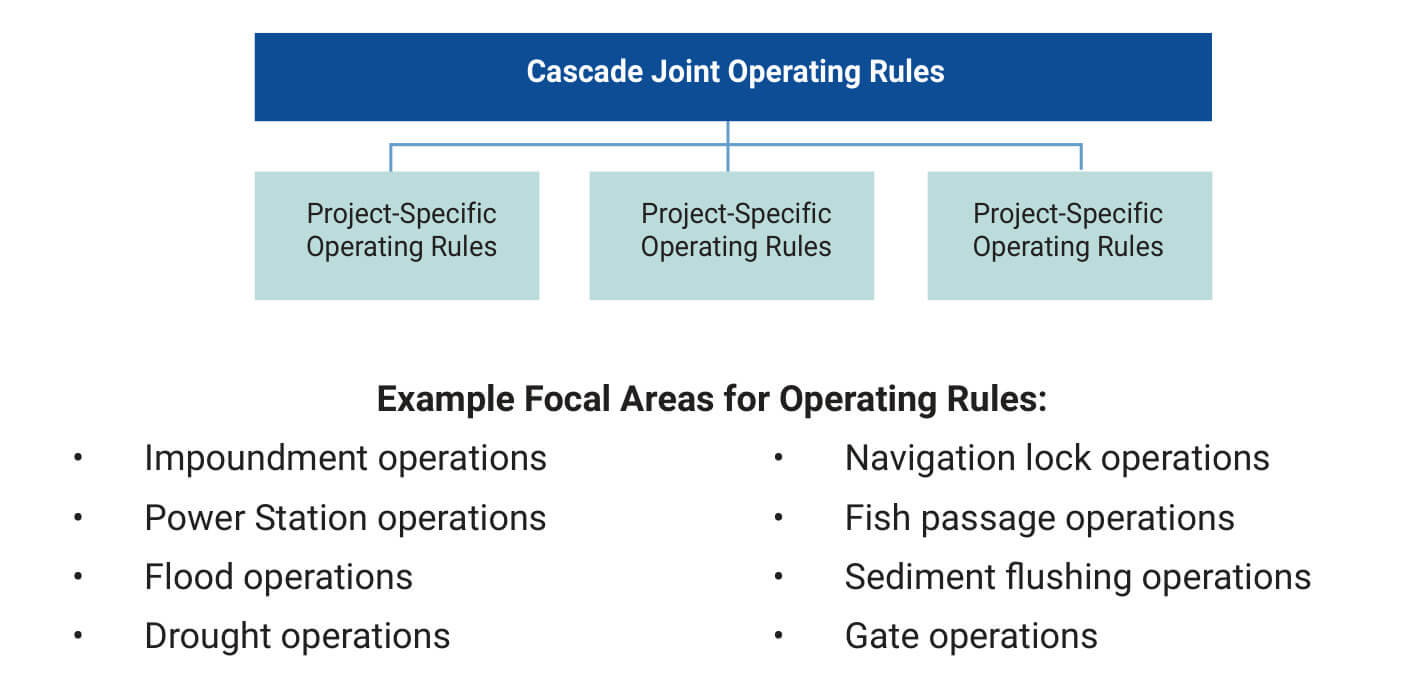
- joint operations within a mainstream hydropower cascade are guided by a common framework informed by this Guidance. This framework will ideally include the Cascade Joint Operating Rules developed by one or more Member Countries in which the projects are located, together with project developers and importing countries. Other Member Countries that may be impacted by the operations of the cascade should be consulted. A framework for Cascade Joint Operating Rules is shown in Figure 1.1.
4. At least 11 large hydropower projects have been proposed on the mainstream reaches of the LMB with two projects (Xayaburi and Don Sahong) currently operational. Whereas implementation of any one or all bring opportunities for economic development of the region, mainly through enhanced electricity supply and improved conditions for inland navigation, the projects will be accompanied by adverse impacts and development risks for Member Countries. These risks will vary in nature and degree depending on the individual project and the extent to which the developer and owner/operator apply this Guidance.
5. This Guidance is founded on the agreed objectives and principles of cooperation set out in Chapter III of the Mekong Agreement, and principles of Integrated Water Resource Management (IWRM). Important underlying principles include:
- Mitigation hierarchy: Avoidance of impacts is preferable to minimization, which is preferable to mitigation of impacts, consistent with the mitigation hierarchy (see further in Clause 6).
- Water as an economic and social good: Water has an economic and social value even when not used for consumption. These values include not only its use in generating hydropower and support national development, but also in providing a wide range of basic human needs and ecological goods and services.
- Adaptive management: Adaptive management is a structured, iterative process of decision-making towards achievement of objectives in the face of uncertainty. The aims are to reduce uncertainty over time via monitoring and improve achievement of objectives via updated management responses to the monitoring findings (see further in Clause 27).
- Good practice: Good practice is the exercise of the degree of skill and care, diligence, compliance, prudence, and foresight that would reasonably and ordinarily be expected from a skilled and experienced developer engaged in any jurisdiction on hydropower projects of a similar scope and complexity to those that are the subject of this Guidance.
- Subsidiarity: Dam owners and operators are best placed to optimize mitigation measures based on their own operations.
- Sovereignty: Consistent with Mekong Agreement Article 4, the Member Countries have the sole authority to regulate developments in their territories, but should require developers to make every effort to apply this Guidance to align with their commitments in the Mekong Agreement.
6. The ‘mitigation hierarchy’ that underpins this Guidance is a concise expression of what is understood to be a sequential process. Measures to avoid or prevent negative or adverse impacts should be prioritized. Where avoidance is not practicable, then minimization of adverse impacts is sought. Where avoidance and minimization are not practicable, then mitigation measures are undertaken. In this Guidance, as per the provisions of Mekong Agreement Articles 7 and 8, these terms are understood as follows:
- Avoid refers to implementing a measure to ensure that any harmful effects do not occur (e.g. by careful planning, siting and design of a project);
- Minimize refers to implementing a measure that, would reduce harmful effects, or the risk of harmful effects, considerably; and
- Mitigate refers to implementing a measure that would reduce the impact of any residual harmful effects on other users of the Mekong River System, including those in the other Member States.
7. Residual impacts are impacts that remain after all viable avoidance, minimization, and mitigation measures have been applied. Measures should be considered to address any residual impact or loss.
8. Wherever practical, this Guidance outlines performance standards rather than prescriptive designs, so developers can innovate and propose alternative mitigation and operational measures to meet the stated objectives., as discussed below:
- Where standards or targets are specified in this Guidance, the project design should align as far as reasonably practical. Where an alternative approach is warranted, the developer should indicate where any deviation has been necessary with supporting evidence.
- In some cases, this Guidance also identifies additional measures that developers could take to further the objectives stated for each topic. Every effort has been made to make it clear what actions or outcomes are considered to be a minimum (with use of the term ‘should’) versus what would be additional (with use of the term ‘may’).
- In some cases, this Guidance refers the user to external sources of guidance. This has been kept to a minimum so that this document can be a cohesive source of consolidated guidance. Where external sources are cited, the text seeks to make it clear where the reference: (i) provides the detail on the desired performance standard that should be followed (this applies to Clauses 263 and 304); or (ii) provides potentially useful additional information on a particular subject.
9. This Guidance is an update of the previous Preliminary Design Guidance for Proposed Mainstream Dams in the Lower Mekong Basin, of 31 August 2009. This update is guided by the experience of application to the first six mainstream hydropower projects, as well as improved understanding about hydropower risk and mitigation in the Mekong region and internationally on what constitutes good practice. Key sources of information include the assessment tools and guidance of the International Hydropower Association (IHA, 2010) and the good practice notes of the International Finance Corporation (IFC, 2018a, 2018b, 2013), tailored to the Mekong context as far as practicable. Knowledge and guidance on good practice in the Mekong Basin is provided in a number of Mekong River Commission (MRC) reports relating to sustainable hydropower. In particular, the MRC’s Hydropower Mitigation Guidelines (MRC, 2018a) provide more detail and examples for how the performance standards in this Guidance can be met.
17. This Guidance is tailored to the Mekong mainstream hydropower projects, which largely involve infrastructure for hydropower generation that is incorporated into the dam facilities and where the river’s flow is returned to the Mekong immediately downstream. These projects may also include irrigation and other uses associated with the mainstream developments.
18. Projects with seasonal or inter-annual water storage or projects that incorporate diversion of flows out of the main channel for substantial distances downstream of the dam are not directly addressed, although many of the same principles and performance standards may apply. Guidance on mitigation of the impacts of these types of projects can be found in the MRC Hydropower Mitigation Guidelines. Guidance for minimizing the impacts of dams constructed for major abstraction of water for other purposes such as irrigation is excluded, noting that dams for this purpose would be subject to the requirements of the MRC Procedure for Maintenance of Flows on the Mainstream.
19. This Guidance focuses on impacts that are of basin-wide concern, because they are transboundary or cumulative, or affect basin-wide processes. There are a number of important processes and/or outcomes for aspects of the shared water resources of the Mekong River that have extensive and even basin-wide dependence or influence:
- The focal areas for this Guidance include the environmental areas of hydrology and hydraulics, sediment transport and geomorphology, water quality, aquatic ecology, and fisheries (Sections 2 to 6). Physical aspects of the environment are addressed first, and then the biological aspects.
- Dam safety and navigation (Sections 7 and 8) are included, because the actions of one project can have ramifications much beyond the individual project and cooperation is essential.
- Riparian communities and river-based livelihoods (Section 9) are included because environmental and infrastructure changes that are not able to be fully mitigated (i.e. the residual impacts) can in turn have socio-economic consequences for river-dependent communities. The socio-economic dimensions of hydropower development on the Mekong River are recognized in the 1995 Mekong Agreement and the MRC vision. Member Country governments maintain the primary responsibility for managing socio-economic impacts within their borders, and may enter into bilateral and/or regional agreements to resolve transboundary issues of mutual interest or concern. The assessment of transboundary impacts to riparian communities and river-based livelihoods thus requires regional cooperation on both assessment of residual transboundary environmental impacts and on the mitigation approach to manage the resulting impacts to these riparian communities. Section 9 provides guidance to support dialogue on this topic during the PNPCA process and beyond, as required under the 1995 Mekong Agreement.
- There are many linkages and inter-dependencies amongst the topics covered by this Guidance. Hydrology and hydraulics link to all other topics. Navigation and dam safety are strongly influenced by flow conditions. Physical changes to habitats (river geomorphology) and water quality arise due to flow changes and have significant influence on aquatic ecology. Fish and fisheries are dependent on conditions and processes relating to flow, habitat, water quality, and aquatic ecology. River-based livelihoods are strongly influenced by all of these factors, and in particular by the effectiveness of mitigation measures or supplementary approaches where livelihoods are dependent on the river environment.
- A number of these focal areas have dedicated procedures and guidelines within the Mekong Agreement Framework, as well as monitoring programmes within the MRCS. Where relevant, these have informed the specific objectives for each topic.
20. Both short-distance and long-distance impacts are addressed in this Guidance.
- Hydrological and hydraulic modelling (as described in Section 2.3) should be used to investigate how far downstream and upstream changes to aspects of the flow regime attributable to the project can be detected. These changes may relate to, for example, daily water level fluctuations, impoundment backwater effects, timing of seasonal changes, and the effects of infrequent operations such as sediment flushing. The distance will vary depending on factors such as dry or wet season, tributary contributions, river geometry, and the operation of other projects.
- Analyses for each focal area covered by this Guidance (Sections 3 to 9) should consider the hydrological and hydraulic modelling to inform where impacts may occur, and should then consider the magnitude and consequence of risk associated with changes attributable to the project. For fish and fisheries (Section 6), river distance affected should consider which species are likely to be unable to pass the dam or to thrive under the changed flow conditions, and the consequent changes to species abundance in river reaches upstream and downstream of the project.
- The pre-project analyses (Clause 23) should always identify those impacts that may be transboundary in nature. Some projects are very close to national borders, hence short-distance impacts may be transboundary. The ESIA for the project should not stop at a national border if the analysis of river distance affected by direct physical changes or indirect changes to species composition and abundance shows that this extends into another country. The MRC Transboundary Environmental Impact Assessment (TbEIA) Guidelines, once approved, are an important reference for Member Countries in identifying and addressing issues of transboundary concern (see MRC, 2023).
21. This document provides guidance to inform design and planning that will have implications for both the construction and operation stages of a dam development, including
- Some design measures2 mitigate construction stage impacts, and many others mitigate longer-term operation stage impacts.
- It is important to take into account intended or likely future operational practices when considering the specifications for, and likely effectiveness of, design features.
- Some risks may be able to be mitigated by operational practices rather than through design of built infrastructure.
2 For example, design of low-set spillway gates will assist in routing and flushing of sediments.
22. The eight topics in this Guidance follow a common logical flow, in which the objectives for each topic inform the identification of risks, potential impacts, mitigation measures, and mitigation effectiveness. The sub-sections in Sections 2 to 9 are as follows:
- Objectives: This sub-section clearly states the objectives of the Guidance, which reflect the commitment and principles in the Mekong Agreement framework.
- Risks: This sub-section outlines the types of risks that may prevent achievement of objectives, and where relevant, highlights interlinkages with other topics. In general, a comprehensive list of all potential risks has been provided. Not all risks will apply to every project, and there may be additional risks that require consideration. The developer will need to undertake studies to prioritize risks and eliminate risks that are not relevant to the particular dam location and layout. Assessment and monitoring of risk mitigation should be reported through national and regional processes (e.g. the PNPCA).
- Pre-project monitoring and analyses: This sub-section provides guidance on the data and analyses that would sufficiently inform and justify the design and operational choices presented in the PNPCA documentation.
- Design and operational guidance: This sub-section guides the identification and evaluation of mitigation options, and provides a basis to justify those that are proposed for implementation. In some cases, more specific outcome targets are presented for particular mitigation measures. Guidance is included on measures that will enable future adaptations if shown to be required by the post-project monitoring.
- Project monitoring and adaptive management: This sub-section advises on the monitoring during project construction and operations that will help show if design and operational measures have been effective, or whether adaptations should be implemented.
23. To adequately inform project design, pre-project monitoring and analyses should:
- be conducted by personnel with appropriate qualifications and expertise relevant to each discipline (see also Clause 31 v);
- provide an accurate, quantitative and qualitative understanding of the pre-project conditions and trends (the “baseline” conditions), and justify the proposed project designs and plans in terms of achieving the objectives and mitigating the risks outlined in Sections 2 to 9 of this Guidance;
- be guided by the implementation of a monitoring network and monitoring programme that takes into account all topics considered in this Guidance. This network may consist of new monitoring stations or sampling locations established and managed by the project developer, plus use of data sources managed by other agencies and accessible to the project. Locations, timing of sampling, methodologies, and duration of data collection should be designed to adequately inform on the variability and risks relevant to the topic, as guided in Sections 2 to 9.
- draw on and supplement existing information and data collection in the Mekong River and tributaries, which may be under the responsibility of national agencies or institutions. Tributaries can have an important influence on the mainstream conditions and should be taken into account;
- draw on the MRC’s monitoring and studies as a basis for interpretation of project-specific data. The MRC data can be accessed by submitting requests through the relevant National Mekong Committee Secretariat (NMCS). To ensure the ability to achieve a wider basis for project-specific data interpretation, the developer should tailor local-scale data collection and methodologies to the wider body of data, and should follow any protocols recommended by the MRC for monitoring throughout the river system, which may be updated from time to time;
- be of sufficient duration to inform projections of future trends and changes, and to provide a certain degree of overlap with existing data sources so that the project-specific data can be extended. Project-specific data collected prior to, and analysed for, the PNPCA information submission should encompass at least one full annual cycle, or longer if possible. The monitoring data should continue to be collected following PNPCA information submission to inform detailed design, and flow on into the construction and operation stage monitoring programmes (Clause 26).
24. Appropriate analyses, including modelling, should be used to predict impacts. These should indicate whether particular risks are relevant to the project, their magnitude and consequence, and the likely effectiveness of various mitigation approaches, as follows:
- Models should be at an appropriate level of detail to inform and justify the design and operations approach proposed at the PNPCA stage.
- The developer should describe the further modelling that will be undertaken for detailed design and optimization of operations.
- The developer may consider the use of the Decision Support Framework (DSF) developed by the MRC as a resource for assessing cumulative and transboundary impacts in the Mekong River, and for informing the development of Cascade Joint Operating Rules. The DSF includes basin-scale hydrological, sediment and water quality models, and relevant input data for these models. Models with equivalent function may be proposed.
25. The information presented on the extent of project impact for each topic and the likely effectiveness of the planned mitigation measures should also identify and analyse the residual impacts that will remain, the communities that will be affected by these residual impacts, and the consequences of those impacts on river-based livelihoods. This is a critical input to the analyses that will be undertaken relating to riparian communities and river-based livelihoods (Section 9).
26. Project monitoring to be undertaken during the detailed design, construction, and operation stages should be described in the PNPCA information as follows:
- The project monitoring plan should describe what data will be collected, how they will be analysed, what indicators will be tracked and why, and how the information will be able to inform timely management responses (see Clause 27).
- The project monitoring plan can serve many uses in addition to ensuring efficacy of project design and mitigation measures. If approaches taken to establish the pre-project condition are continued during project construction and operation, this will enable post-project comparisons. The project monitoring should also consider how emerging risks may be detected over time, including those that arise from activities other than the project but that may pose management problems for the project.
- The project monitoring plan should show how it has considered and planned for the range of project monitoring purposes and factored in the locations of (and permanent instrumentation for, if relevant) monitoring stations and ensured access.
- The project monitoring plan should be informed by, and as far as practical align with, MRC processes for Joint Environmental Monitoring throughout the river system if and when this is agreed by the Member Countries.
- For data that are not of a commercially sensitive nature, the developer should contribute to information-sharing mechanisms set up in accordance with the Procedures for Data and Information Exchange and Sharing (PDIES) (see MRC, 2001). Information sharing is critical to the effective coordination, harmonized design and operations of the mainstream hydropower projects.
27. Adaptive management is a principle underpinning this Guidance, as defined in Clause 5. The following guidance on design features to support future adaptive management is provided in the sub-section entitled, Design and operational guidance:
- Mitigation measures may be implemented on a trial basis, and design features should be built into the project to allow for later adaptation if required.
- Uncertainties in aspects of effectiveness of proposed mitigation measures (e.g. for built structures, operational rules) should be explained, and follow-up monitoring and review of these areas of uncertainty should be built into the project monitoring plan.
- The project monitoring plan submitted with the PNPCA information should show what indicators and thresholds will guide decisions to be made on adaptive management, what adaptations could be made and why, how the project design factors in the ability to implement these later adaptations, and ensures adequate contingency funding has been set aside to undertake these possible adaptation steps.
- The project monitoring plan submitted with the PNPCA information should show that both riverine and impoundment monitoring results will be reviewed annually, and should identify the decision-making process that will be used to identify and implement management actions to be taken if risks or impacts are evident from the monitoring results.
28. Developers should consider the applicability of this Guidance to the unique setting and features of their project, and make the case for variations to this Guidance if needed, in line with Clauses 8 and 20. Activities and structures upstream and downstream of the project may require special consideration on how to apply this Guidance, as well as the locations and significance of tributary inflows and influences. The order of project development is an important consideration, and existing and planned hydropower projects should be taken into account.
29. Where a development will be part of a cascade, the developer should show in the PNPCA information how it will follow any Cascade Joint Operating Rules provided by the responsible Member Countries. In the absence of such rules, the developer should indicate how it will, through the responsible national agency, liaise with neighbouring projects to develop Cascade Joint Operating Rules associated with mitigation and operations. Cascade-level mitigation approaches can be informed by the MRC Hydropower Mitigation Guidelines, which also include case studies relating to hydropower cascades.
30. The PNPCA Clauses 4.2.1 and 5.2.1 describes the technical data and information to be provided by the notifying country. Should the MRC Joint Committee or the other Member Countries request any further data and information or clarifications during the prior consultation process, the notifying country should employ its best efforts to provide such information should the data be readily available and not present a risk to national security or national defence. The information submitted for PNPCA should allow the MRC JC to evaluate that:
- project developers and the notifying country have made every effort to align the design, construction and operation of the infrastructure with this Guidance;
- Deviations from the Guidance are motivated based on site-specific information gathered and risk evaluation;
- the proposed design and planned cascade operations will effectively mitigate the impacts and risks described in this Guidance;
- information collection, analysis, design, and development of detailed operating rules, which are required by this Guidance, are proposed to be undertaken after the PNPCA, are clearly listed and the planned approach documented;
- these additional data are to be made available as part of any agreed post PNPCA process (Joint Action Plan) and to foster cooperation on improvements and adaptive management of mainstream hydropower.
31. In addition to the guidance on data and information that may be submitted with PNPCA documentation outlined in this and the following sections, PNPCA information should include:
- Planned Project-Specific Operating Rules, or at a minimum, the operating principles and objectives, for the impoundment, for downstream discharges, for gates, and for any mitigation structures;
- Cascade Joint Operating Rules, or at a minimum the cascade joint operating principles and objectives, where the project is part of a cascade (see Clause 3);
- a set of relevant design drawings with labelling in English;
- clear maps and figures, using an appropriate scale, that are easy to understand, interpret, and relate to the explanations provided; and
- a list of the experts used for the topics addressed by this Guidance, and their qualifications.
32. It is recommended that a checklist be submitted with the information for PNPCA technical review that identifies where each clause of this Guidance is addressed.
33. The Guidance, with the support of the Secretariat, shall be updated from time-to-time, based on:
- the further experience of application of this Guidance on Mekong dam developments;
- the development and application of processes for improved coordination of developments, including but not limited to, the Transboundary Environmental Impact Assessment (TbEIA) Guidelines, Cascade Joint Operating Rules, and Joint Environmental Monitoring.
Use the interactive database below to search, filter, and download formal guidance documents, technical papers, and checklists for this topic.
| Title | Date | Type | Size | Link |
|---|---|---|---|---|
| MRC (2023). Guidelines | 2026/09/09 | 8.0 MB | Download | |
| MRC. (2003a). Procedures-Notification-Prior-Consultation-Agreement | 2026/09/09 | 2.0 MB | Download | |
| MRC. (2001). PDIES-4 | 2026/09/09 | 69 KB | Download | |
| MRC. (1995). Agreement-on-the-Cooperation | 2026/09/09 | 304 KB | Download | |
| IHA. (2010) | 2026/09/09 | 1.4 MB | Download | |
| IFC. (2018b) | 2026/09/09 | 2.6 MB | Download | |
| IFC. (2018a) | 2026/09/09 | 7.2 MB | Download | |
| IFC. (2013) | 2026/07/08 | 1.4 MB | Download |
Use the interactive database below to search, filter, and download formal guidance documents, technical papers, and checklists for this topic.
| Title | Date | Type | Size | Link |
|---|