Frequently Asked Questions
Answers to common questions about the Preliminary Design Guidance (PDG) 2022, its implementation, and this Resource Hub.
No matching questions on this page.
The PDG 2022 is the shortened title for the Preliminary Design Guidance for Proposed Mainstream Dams in the Lower Mekong River Basin and is a set of performance targets and design principles, endorsed by the MRC Council in 2022, to avoid, minimise and mitigate the transboundary environmental, social and safety risks of proposed mainstream dams.
The original PDG was first approved in 2009 and gave developers and Member Countries a common technical reference. It was comprehensively updated over a five-year process, with approval in 2022 to reflect new evidence, expand the topics covered, and align with international good practice.
The 2022 update expanded and deepened the topics, incorporated new evidence from MRC studies, and strengthened the social and environmental content, while keeping the same purpose of guiding sustainable mainstream-dam design.
Two new topics were added: (1) Riparian Communities and Livelihoods and (2) Hydrology and Hydraulics as well as additional requirements in the existing topics.
Developers, operators, consultants, regulators, policymakers, academics and civil society across the Lower Mekong River Basin.
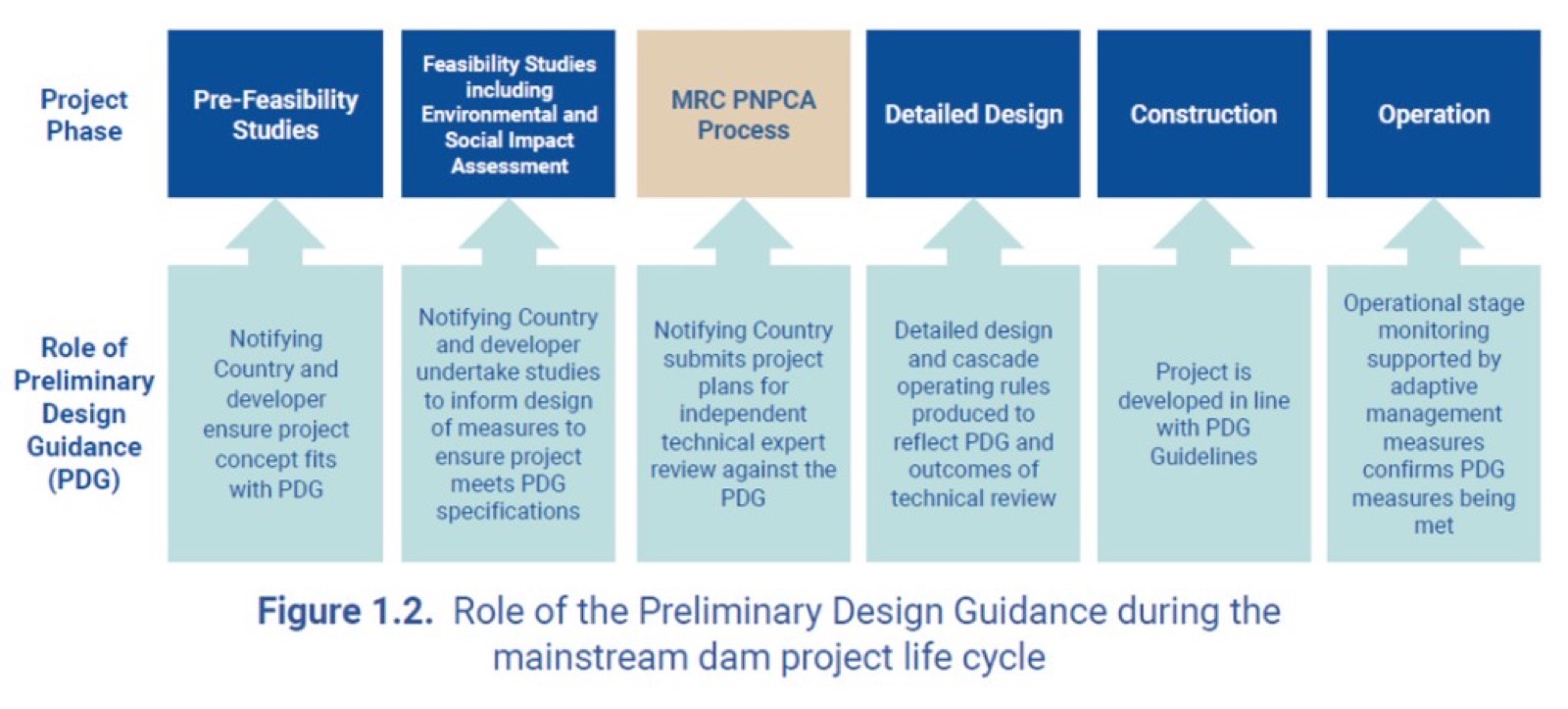
The PDG provides the performance guidelines when a proposed mainstream dam is reviewed through the Procedures for Notification, Prior Consultation and Agreement (PNPCA).
No. The PDG is guidance. It sets performance targets and good-practice principles; project outcomes under the PNPCA are captured in a Statement and Joint Action Plan. Prior Consultation confers no veto.
8 topics: (1) Hydrology and Hydraulics; (2) Sediment Transport and Geomorphology; (3) Water Quality; (4) Aquatic Ecology; (5) Fish and Fisheries; (6) Dam Safety; (7) Navigation; and (8) Riparian Communities and River-Based Livelihoods.
The PDG 2022 is focused on transboundary and regional environmental and social issues associated with dams on the Lower Mekong River Basin. It does not cover environmental and social issues contained within a nation's boundaries. These are covered by national laws and regulations. This means not all topics related to sustainable hydropower are included in the PDG, but they are included in the project through national mechanisms. For example, resettlement is not included in the PDG.
The MRC Hydropower Mitigation Guidelines (HMG) (Volumes 1, 2 and 3) are a set of technical guidelines developed by the MRC to help MRC Member Countries and hydropower developers avoid, minimise and mitigate environmental, social and transboundary impacts from hydropower projects.
The Hydropower Mitigation Guidelines provide the broader and more technically focused assessment and management framework, while the PDG provides more specific design and operating expectations for proposed mainstream dams.
Still have questions?
For any question about the PDG or this hub, contact mrcs@mrcmekong.org.